

Written by: Hilary Martin
The homework ahead of Canada’s federal political parties and their leaders
For the country’s leaders and their teams, the summers are rarely quiet, but do offer a chance to reflect and take stock of where they stand with Canadians. It is useful, with the House adjourned until September, to look beyond the topline vote intent to identify the trends, pockets of support and/or opposition that feed into these numbers and fold what you learn into the rest of your summer planning and fall strategy.
As part of our May 2026 omnibus survey, Earnscliffe’s research team took a deeper look at each national political party’s voter universe – what does their base look like, who are their possible supporters, and who says they would never vote for them. These groups give you a sense of the health of each party beyond the horserace and offer a roadmap that can guide messaging, communications targeting, and the leader’s engagements over the summer. Let’s begin with the topline:
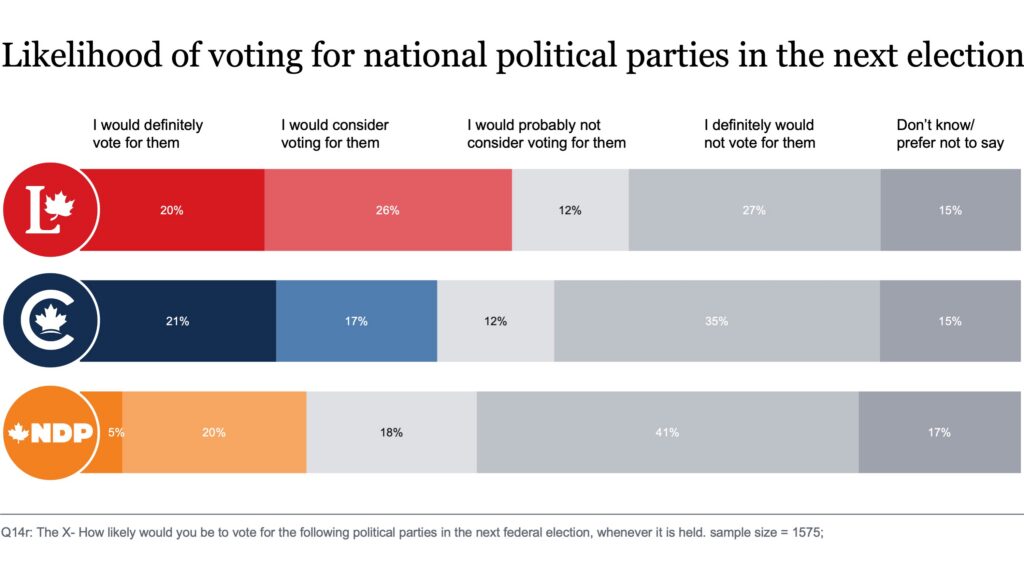
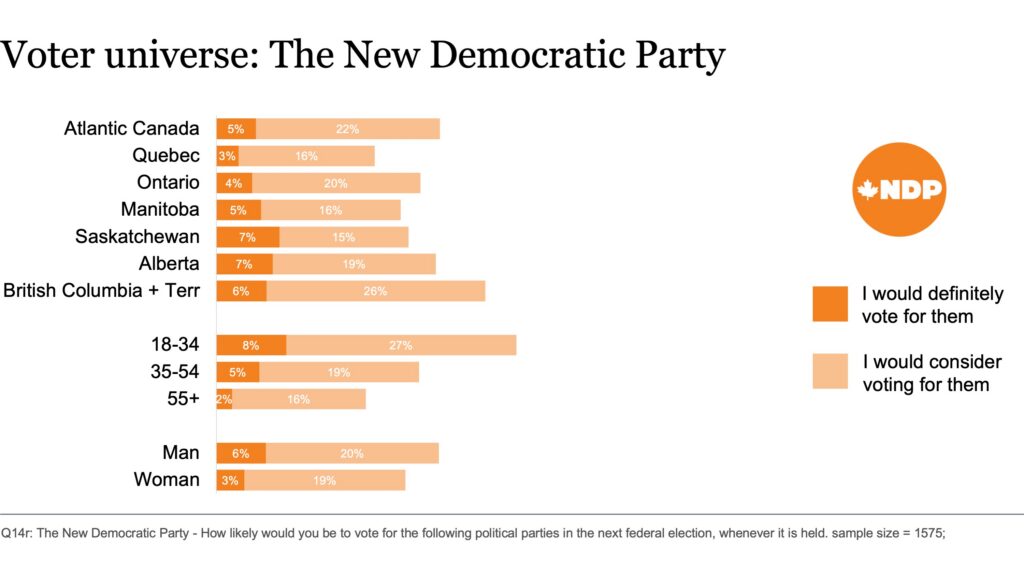
When it comes to core supporters, about one-fifth of voters say they would “definitely” vote for either the Liberals (20%) or the Conservatives (21%) in the next federal election. Conventional wisdom has held that the Conservative base tends to be the most solid long-term, but for now, the Liberals’ core support seems equally strong. The NDP’s group of committed voters is much smaller in comparison, at just 5%. This is not surprising, but no doubt troubling for the new Leader’s Office.
Moving to the possible supporters, the Liberals’ have the highest ceiling, with 26% saying they would “consider” voting for them in the next election. This high ceiling is driving their topline polling advantage today. Fewer (17%) would consider supporting the Conservatives, while 20% would consider the NDP. Adding their committed and possible supporters together, the size of each party’s voter universe looks like this:
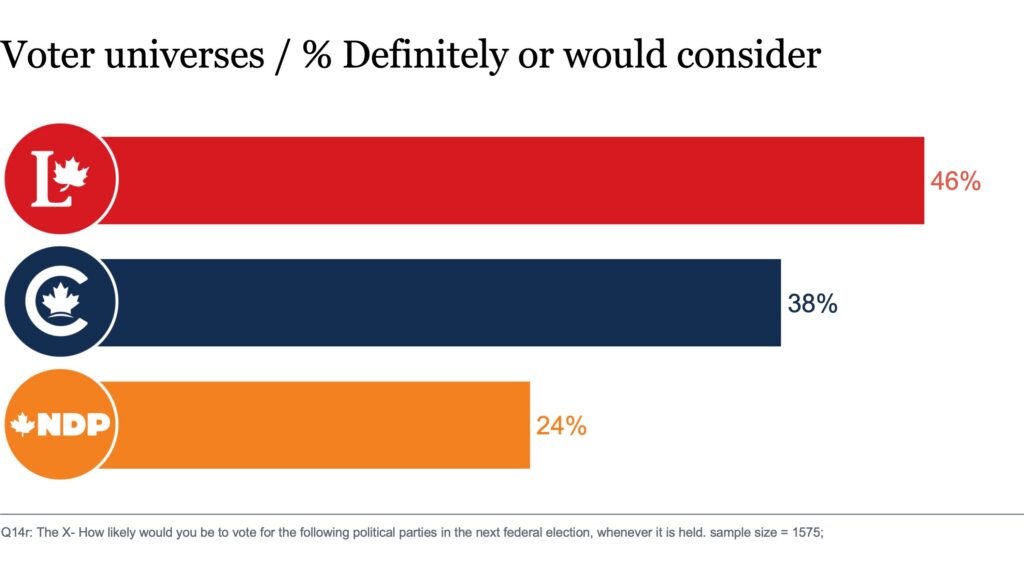
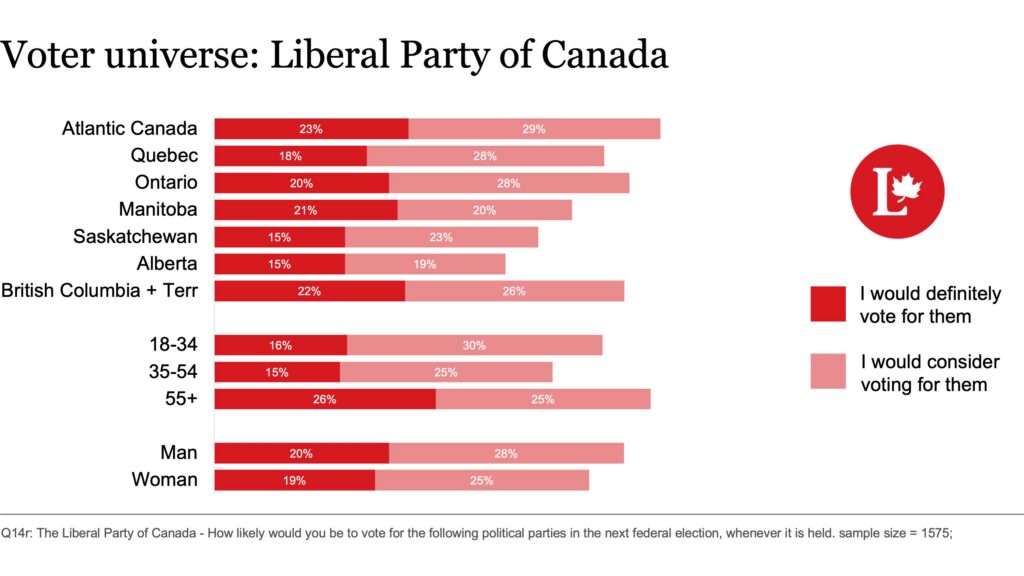
On the surface, this data looks quite promising for the Liberals. Close to half (46%) of Canadian voters are available to them, far ahead of the Conservatives at 38%. Their voter universe looks sizeable in key regions, like Ontario (48%), Quebec (46%) and BC (48%). However, it would be a mistake to take the support the party has built up for granted. The Carney government should still pay attention to where their support is weaker – specifically among those under 55. The numbers are very strong among older Canadians, with 51% saying they would be open to voting Liberal, including 26% who would “definitely” vote Liberal. Support is softer among those 18-34 and 35-54: 16% of those 18-34 and 15% of those 35-54 are definite supporters. In government, risk tolerance across communications tactics that would reach younger Canadians more effectively is lower, but reinforcing support among these groups should remain a priority. The government will also have to fight against the pull of the news of the day, so often dominated by international issues these days, to drive their messages about affordability and housing, which tend to be more important to younger voters.
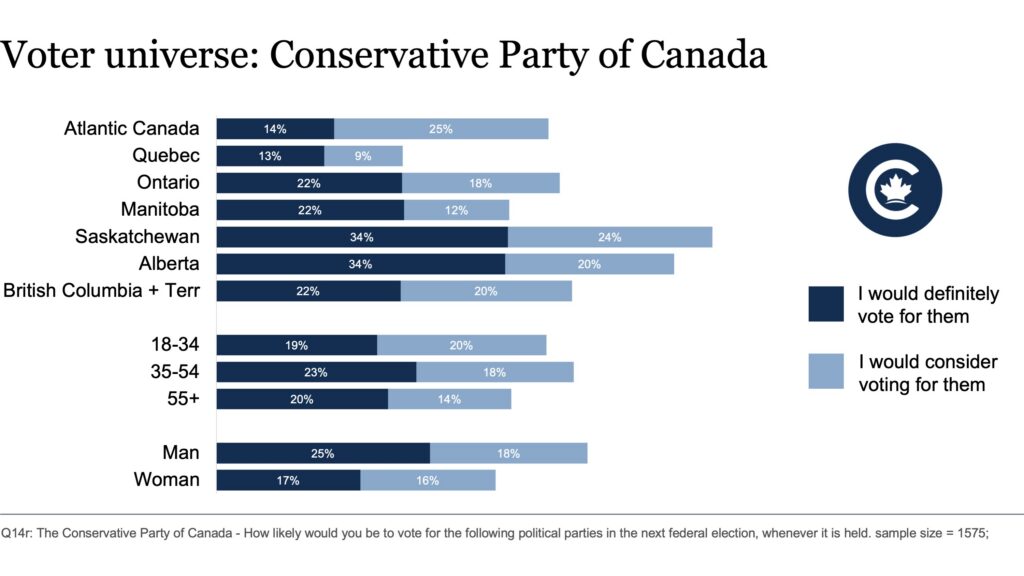
Turning to the Conservatives, their regional strength in Saskatchewan and Alberta persists, where 34% are certain to vote for them. With Pierre Poilievre committed to the “remain” camp in the upcoming referendum, Alberta is no doubt a major factor in his summer tour schedule. But, as is often the case, the strategy will need to include key regions in Ontario and BC. The Tories can still be competitive in both, but their ceiling, at 40% in Ontario and 42% in BC, is lower than the Liberals’. The path back to a fighting chance at government surely runs through both regions.
The Conservatives’ appeal is strongest among voters 35-54, with 23% definitely and 18% open to considering voting for them. Among this group, they are on even footing with the Liberals. However, they are at a disadvantage among those 18-34 and in particular, those 55+. In fact, 40% of voters 55+ say they would definitely not vote Conservative. Digging deeper into how, if at all, the party could make itself a viable option for more older voters again seems necessary.
Finally, the numbers clearly show that the NDP’s summer planning should be focused on rebuilding. This includes understanding their new leader’s appeal, to pitch him more widely come the fall. We saw in the same poll that over half of Canadians cannot offer an opinion about Avi Lewis when asked, and among those aware of him, impressions are net negative (15% positive, 24% negative, for a net-9). They should also be considering how to build and solidify support among the pockets of voters where their appeal is broadest, including young voters 18-34 (8% definitely would vote NDP, 27% would consider) and in BC (6% definitely would vote NDP, 26% would consider).
The House may have risen, but the work never stops. The federal parties’ understanding of where opportunities and threats lie and the planning that flows from that knowledge set up dynamics for the rest of the year.
The online survey, conducted by Earnscliffe’s opinion research team, was in field from May 27-29, 2026, and engaged a representative stratified sample of 1,657 respondents living in Canada 18 years or older who are members of Leger’s LEO panel (with an effective sample size of 1,175). Respondents had the option of completing the survey in French or English. For comparison purposes only, a probability sample of this size would have a margin of error of +/- 2.41 at a confidence level of 95%. The data was weighted by age, gender and region based on Census 2021 data and self-reported past vote based on 2025 federal election results and turnout.
The research was conducted on Earnscliffe’s omnibus survey.
Earnscliffe is a member of CRIC and abides by the ESOMAR code of Market, Opinion, and Social Research and Data Analytics and CRIC standards, including the CRIC Public Opinion Research Standards and Disclosure Requirements.
For further information, please contact Hilary Martin (hmartin@earnscliffe.ca).
For question wording and data tables, please click here.