
The House of Commons returns to sitting on Monday, September 21. The Senate will return the following week, on September 28.
The collapse of the Canada-U.S. trade negotiations on August 21 continues to be the dominant political and economic issue for the foreseeable future. Fallout since Canada withdrew from the negotiations has included:
- Competing explanations of the end of the talks from the negotiating teams on both sides;
- Immediate U.S. imposition of additional Section 338 tariffs on roughly $20 billion Canadian goods, followed by Canadian counter-tariffs on several hundred U.S. imports on September 8;
- Canada’s $7.5 billion package to enhance several of its tariff-relief programs to help insulate Canadian companies and workers from the impacts of the U.S. counter-tariffs;
- Additional tit-for-tat U.S. tariffs and product exclusions on September 8 to respond to Canada’s counter-tariffs.
Throughout this period, Canada and the Prime Minister have been the target of increasingly insulting and belittling remarks and jibes from President Trump and various U.S. Cabinet secretaries. It is increasingly clear that this is no longer merely a trade dispute, but that the United States intends to teach Canada a lesson for fighting back against its dictatorial approaches. As the Prime Minister has said on several occasions, “America wants to break us, so it can own us”.
In the past week, the Prime Minister continued pursuing economic and trade diversification away from the United States by convening the Canada Investment Summit, speaking to the European Parliament and initiating negotiations of closer ties with the EU.
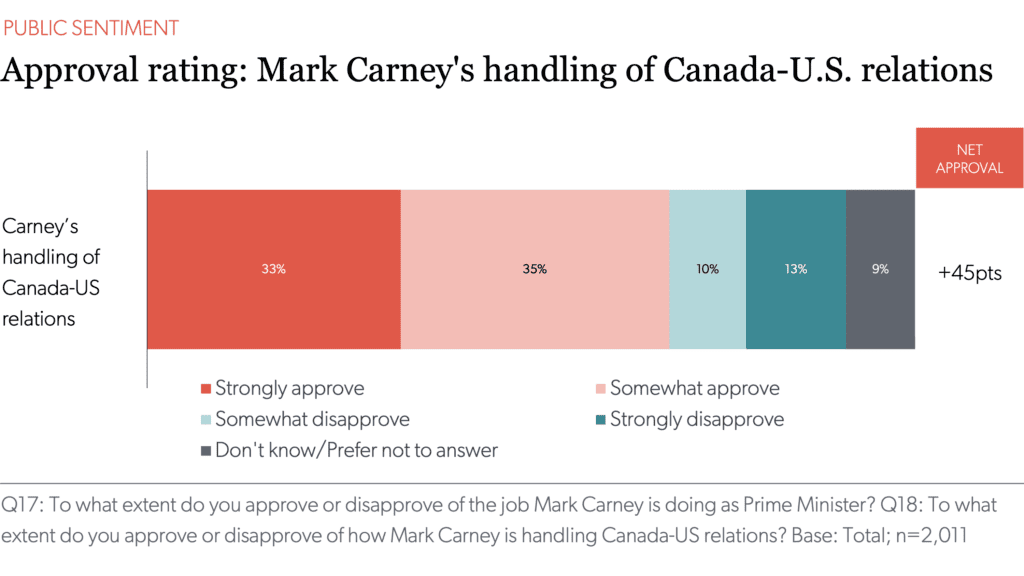
Earnscliffe’s own polling shows widespread support for the Prime Minister’s overall approach to dealing with the U.S.; over two-thirds (68%) approve.
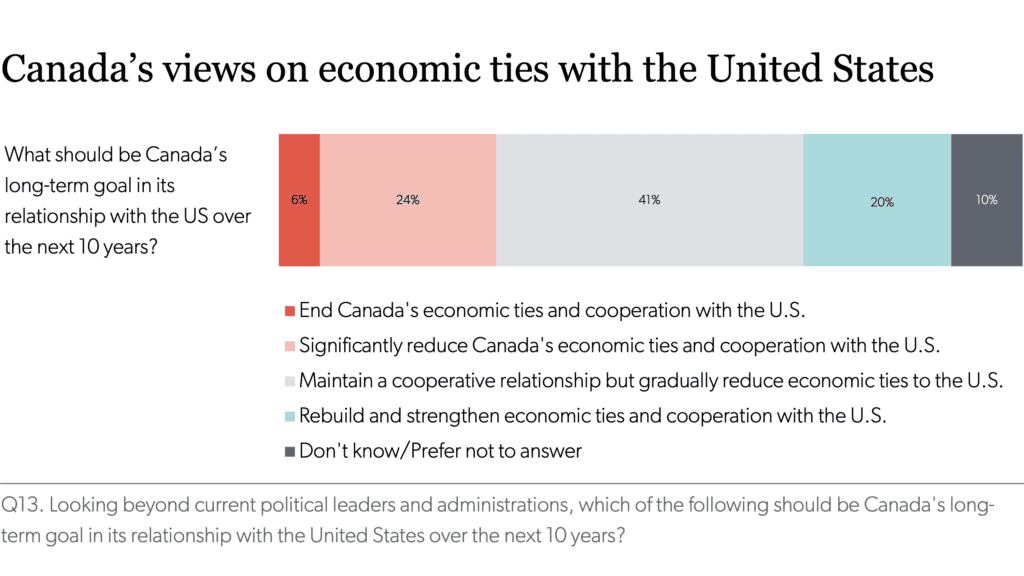
Canadians are also broadly aligned with the Prime Minister’s mission to reduce dependency on the US, though the degree to which they believe ties should be reduced varies. Overall, seven-in-ten (71%) Canadians think Canada should reduce its economic ties with the United States over the next ten years. The plurality (41%) favour maintaining cooperation while gradually reducing economic ties, while 24% say Canada should significantly reduce economic ties and cooperation. Few (6%) believe that Canada should end economic ties and cooperation entirely.
Finally, in byelections held on August 31, the Liberals swept all three seats in Ontario, B.C. and Quebec.
Collapse of the trade talks
Canada’s position
In his August 26 news conference Prime Minister Carney said that Canada ended the talks because Washington introduced “last-minute changes” that Canada viewed as unfair and uneconomic, that undermined Canada’s sovereignty, and reduced confidence in the reliability of the potential agreement. He also indicated that the U.S. demanded a say in Canada’s future trade arrangements with other countries. His summary was blunt: “They asked too much and offered too little.”
According to Carney, U.S. negotiators also sought changes affecting a range of Canadian cultural protections and online discoverability of French-language television and cultural materials. The Canadian government regarded these as sovereignty issues and was unwilling to concede. Canada also alleged that the Americans introduced changes late in the talks that would block Canadian sales of medium and heavy trucks in the U.S.
The U.S. position
U.S. Trade Representative Jamieson Greer denied that the White House had asked for a say in the trade deals Canada makes with other countries. He said the administration wanted to prioritize co-operation, referring to the Fortress North America concept floated most prominently by Ontario Premier Doug Ford. On the issue of discoverability of French content on streaming services, Greer said it had been “highlighted” by the White House but not as a dealbreaker.
Greer threatened a tit-for-tat retaliatory response from the U.S. after Canada announced dollar-for-dollar counter-tariffs against American products to take effect after Labour Day. And since the end of the talks, President Trump and members of his Cabinet have continued trolling Canada almost daily and Trump has renamed Lake Ontario “Lake America”.
The counter-tariff debate
Immediately after Canada announced its September 8 counter-tariffs, it withdrew seafood from the targeted sectors, touching off a spirited debate over whether Canada’s response hits Canadians hard, as well as damaging the Americans.
The most common criticism is that because tariffs are effectively a tax on imports, Canadian businesses importing U.S. products will face higher costs, which will need to be passed on to consumers through higher prices, or will make Canadian production uneconomic. Critics argue that while the intent is to punish the United States, a significant portion of the economic burden falls on Canadians.
It is becoming clear that the Americans are going through a similar calculus. In releasing their recent round of retaliatory measures on September 8, the U.S. removed several commodities from their earlier tariffs on Canada – road salt, cement, toilet paper and sugar – suggesting they had come to realize that they actually needed these products and that it was against their own interests to tariff them.
How might the current impasse end?
While Canada was relatively restrained in explaining its withdrawal from the negotiations, the U.S. has been aggressive, personal and belligerent since the break-off of negotiations. The current highly charged situation has now spiralled into a series of tit-for-tat tariff retaliations, with neither side willing to yield to the other. It is also clear that the President is not interested in a win-win solution to the trade issues.
The Carney government currently enjoys substantial and widespread public support for its decision to walk away from the recent talks, despite the economic consequences.
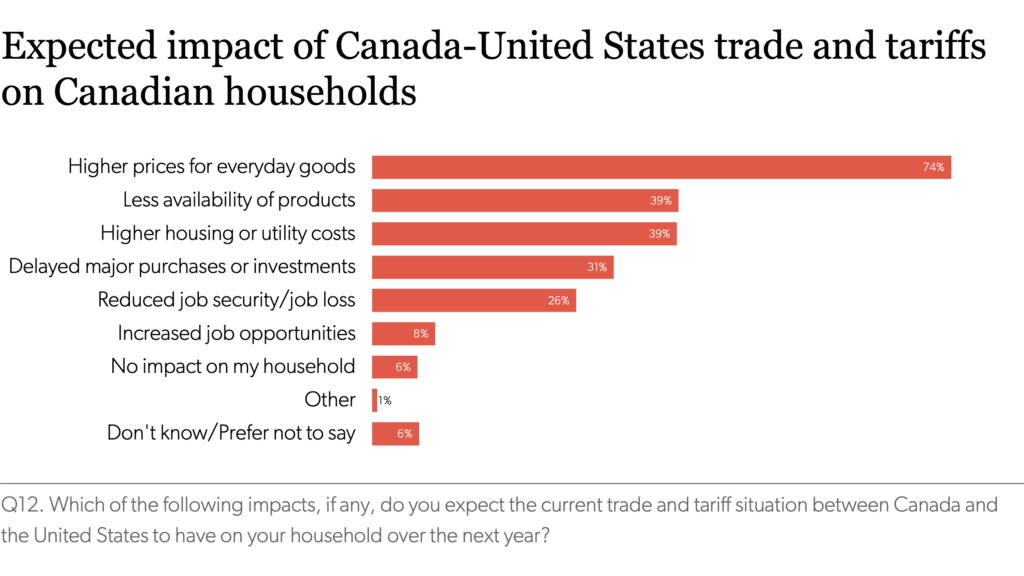
Our recent polling suggests Canadians understand that there may be some economic pain ahead to endure. Three-quarters (74%) of Canadians expect higher prices for everyday goods, 40% expect increased housing or utility costs, and 31% expect to delay major purchases or investments to be delayed. Beyond the impact on household costs, 39% of Canadians expect reduced product availability while 26% expect reduced job security or job loss. Anticipated job loss is slightly higher in Ontario (30%) than British Columbia (22%), reflecting a more interconnected job market with the United States.
Carney has Canadians’ backing to persevere for now. However, in the longer term, they may be less forgiving if his mission to reduce Canada’s dependency on the U.S. leads to more supply chain disruptions, higher prices and growing job losses. Our research finds that these are three potential consequences of seeking greater independence from the U.S. that Canadians are less willing to accept. While Canadians are more comfortable with the government increasing spending to support businesses (35% are comfortable accepting this), higher taxes to fund such support would not be well-received (27% would not accept this).
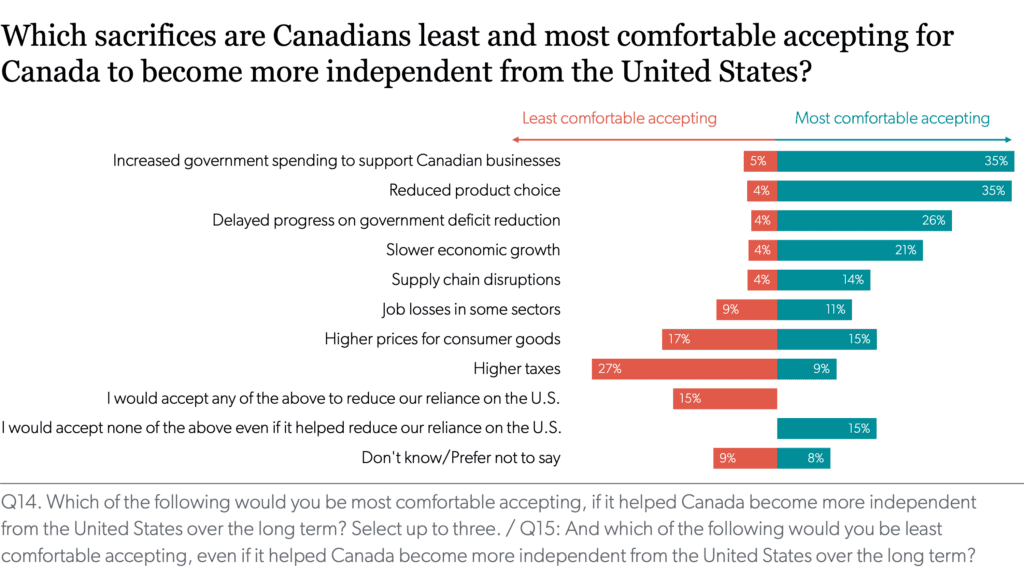
In contrast, pressure from business and the public is catching up to the Trump administration in key swing states that have significant trade links with Canada. Michigan voters disapprove of Trump’s tariffs on Canada by more than a two-to-one margin, according to a new poll from the Detroit News and local station WDIV. While it is still several weeks until the mid-term elections in the first week of November, there are two additional hopeful signs of a resumption of the trade talks. First, the two most recent sets of tariffs from both sides were carefully constructed and while substantial, only minimally elevated the tension between the two countries. Second, Finance Minister Champagne indicated on September 9 that the two sides are continuing informal contacts.
It remains unclear as to when and how the two sides may return to the bargaining table. When they do, renewed talks could lead to a narrower sector-by-sector deal being reached first, with wider issues addressed in ensuing CUSMA negotiations.
The national economy
The recent numbers
The latest statistics indicate a stronger national economy on several fronts:
- GDP growth surged by 3.3% in the second quarter of 2026.
- Total exports rose by 3.6% in Q2, led by a 27.0% increase in passenger cars and light trucks following earlier supply chain slowdowns.
- Higher oil production and energy exports – bolstered by shifting global energy dynamics – contributed heavily to goods-producing industry gains.
- Business capital investment ticked upward, ending several consecutive quarters of decline.
On September 2, the Bank of Canada has held its benchmark interest rate at 2.25%, with monetary policy aimed at stimulating economic activity while mitigating upward price pressures. The BoC also expressed concern about the continuing influence of inflation on affordability. Finally, on September 2, the government extended the GST holiday on gasoline and diesel fuel to the end of 2026.
Rising foreign direct investment
In 2025, foreign direct investment (FDI) into Canada reached between $93 billion and $96.8 billion, its highest level since 2007. While President Trump recently secured control of 65 billion barrels of oil reserves in Venezuela, U.S. energy private equity investors are steering clear of that country and investing heavily in Canadian oil and gas infrastructure:
- Enbridge’s B.C. Pipeline Expansion: Calgary-based Enbridge Inc. secured a $2.7 billion investment from two huge U.S. private equity firms, KKR & Co. and Apollo Global Management.
- ConocoPhillips: The Houston-based company invested US$593 million into its Alberta operations in 2025 and is on track to maintain that exact spending pace through 2026.
- Imperial Oil Limited: Exxon’s Calgary-based subsidiary plans to spend up to $2.2 billion this year on expanding its oil sands projects and upgrading refineries near Edmonton and Sarnia.
In addition, Trans Mountain Corp. pumped $450 million into federal coffers over the past three months, as the company’s pipeline from the oil sands to the Pacific coast ran near capacity and the company is preparing for massive expansion.
The Canada Investment Summit
The federal government hosted the Canada Investment Summit on September 14-15, drawing 250 heavyweight financial-sector executives who lead global companies that collectively oversee nearly $120 trillion in assets.
At the summit, the Prime Minister announced four major policy initiatives to spur investment in Canada: federal funding for a new national internet, a major expansion of immediate expensing for business investment, a move toward private operation of Canada’s largest airports, reported plans to strengthen Ottawa’s ability to address damaging labour disruptions:
- In his opening address, the PM announced that the federal government will help finance a new internet network to provide nationwide sovereign connectivity and introduce new tax measures to lower the cost of building fibre-optic cables.
- The proposed Productivity Mega Deduction will permanently allow businesses to deduct the full cost of eligible investments upfront, expanding coverage from roughly 15 percent to about two-thirds of capital investment. This would lower Canada’s marginal effective tax rate on new business investment from about 13 percent to 6.4 percent, compared with 16.9 percent in the United States.
- Ottawa is proposing to offer private investment through long-term concessions to operate Toronto, Montreal, Vancouver, and Calgary’s airports, retaining ownership of the underlying land and assets.
- The National Post’s John Ivison reported this week that the government is preparing legislative reforms to better protect supply chains and critical infrastructure in cases of labour disruptions, with options for earlier intervention by a special mediator and a path to binding arbitration.
Courtesy of the Globe and Mail, here is a running list of the major announcements that came out of this week’s summit.
The Alberta Referendum
As of mid-September, and with a month to go to October 19, the Alberta referendum campaign is entering a more intense phase. In early September, Elections Alberta reported a surge in requests for mail-in ballots, with 290,000 applications, nearly five times the level seen in the 2023 provincial election. Election officials have suggested turnout could reach 85%, which would be unprecedented in Alberta’s modern electoral history.
The most recent major polling from the Angus Reid Institute reported that 61% would vote for Alberta to remain in Canada, while 33% would support beginning the legal process toward a future binding separation referendum. Among those supporting the “leave” option, 41% say their vote is primarily intended as a message to Ottawa rather than an endorsement of actual independence. Concerns are being expressed about the “leave” proponents being more motivated to get out their vote, which increases the need for the “remain” forces to be better organized than they are currently.
Recent public forums and debates have increasingly shifted from symbolic grievances toward practical questions:
- Currency and central banking
- CPP pensions
- Trade access and border issues
- Indigenous treaties
- Division of federal assets and debt
- International recognition and trade agreements
Both sides of the debate have recently released major reports estimating the potential economic costs and risks of separation.
Mark Carney addresses European Parliament
In her State of the Union speech, European Commission President Ursulla Von Der Leyen announced Canada will have the chance to become the bloc’s first “associate member.” In response, Prime Minister Carney called for a “deeper partnership” between Canada and Europe in order to hedge against great powers encroaching on the sovereignty of smaller nations. “Together, Canada and the European Union can anchor our ground to hold our values while forming a protective canopy under which our citizens can thrive.” He also told the EU Parliament, “We are not fair-weather allies. We do not pursue zero-sum deals,” Carney said. “We hold common values, for which we have always fought, and in whose defence we must always remain vigilant.”The exact details of what the new arrangement will entail remain to be worked out, but Carney proposed in his speech that Canada join Erasmus+, the EU’s program supporting education, training, youth and sport. The prime minister also said Canada could join the EU’s Horizon research grant program. Whatever the details, President Trump doesn’t like the proposed arrangement, calling the idea of Canada and the EU seeking to strengthen their partnership “laughable” and threatened the European Union with “very serious tariffs” if it makes a trade deal with Canada “with bad intentions.”
The Fall legislative agenda
When it returns next Monday, the Houde of Commons with return to the legislative agenda it was considering last June. Key bills include:
- Bill C-22: An Act Respecting Lawful Access – Currently at Second Reading in the Senate
- Bill C-29: An Act to establish the Financial Crimes Agency and to make consequential amendments to certain Acts and regulations – to be studied by the Standing Committee on Justice and Human Rights
- Bill C-31: Budget Implementation Act II – To be studied at the Standing Committee on Finance, as well as Pre-Study in the Senate.
- Bill C-34: An Act to enact the Digital Safety Act and the Digital Safety Commission of Canada Act and to make consequential amendments to other Acts – Currently at Second Reading.
- Bill C-35: An Act respecting the prohibition of the importation of goods produced by forced labour – Currently at Second Reading.
- Bill C-36: An Act to enact the Protecting Privacy and Consumer Data Act, to amend the Personal Information Protection and Electronic Documents Act and to make amendments to other Acts – Currently at Second Reading.
The political landscape
The Liberals
The most notable political development over the summer – the collapse of the Canada-U.S. trade talks – has powered the Liberals to a solid 13 percentage point lead over the Conservatives, according to the polling aggregator 338Canada:
As of August 31, the Liberals are at 46% support, ahead of the Conservatives at 33%, with the NDP at 11%, the Bloc at 6% and the Greens at 3%. Some individual polls have the Liberals leading by as much as 20 points over the Conservatives.
According to a recent poll by Earnscliffe, more than two thirds (64%) of Canadians approve of the job Mark Carney is doing as Prime Minister, with a net approval rating of +38 points. Meanwhile, just under six-in-ten (57%) say the federal government is generally on right track, while a quarter (24%) say it is on the wrong track.
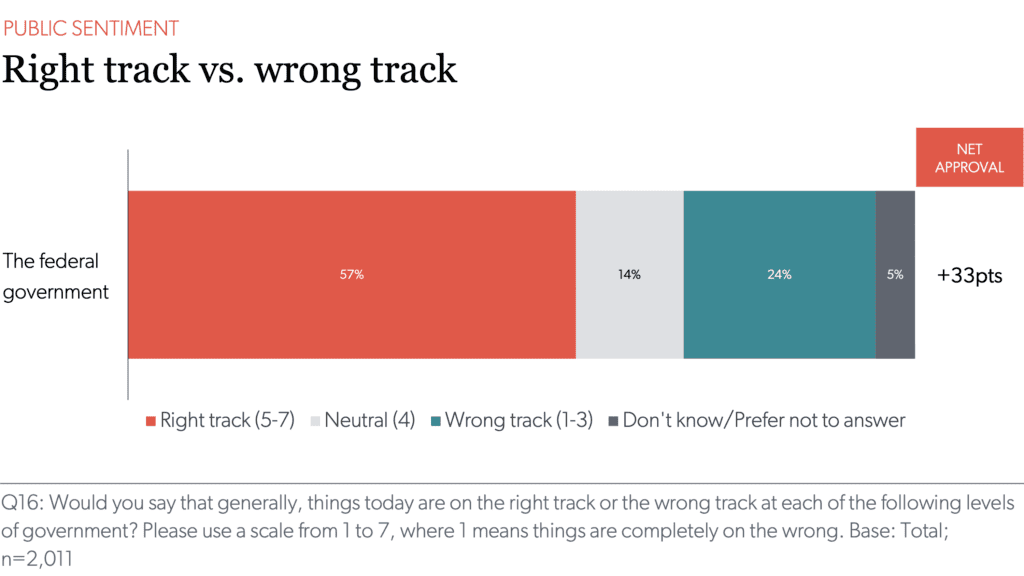
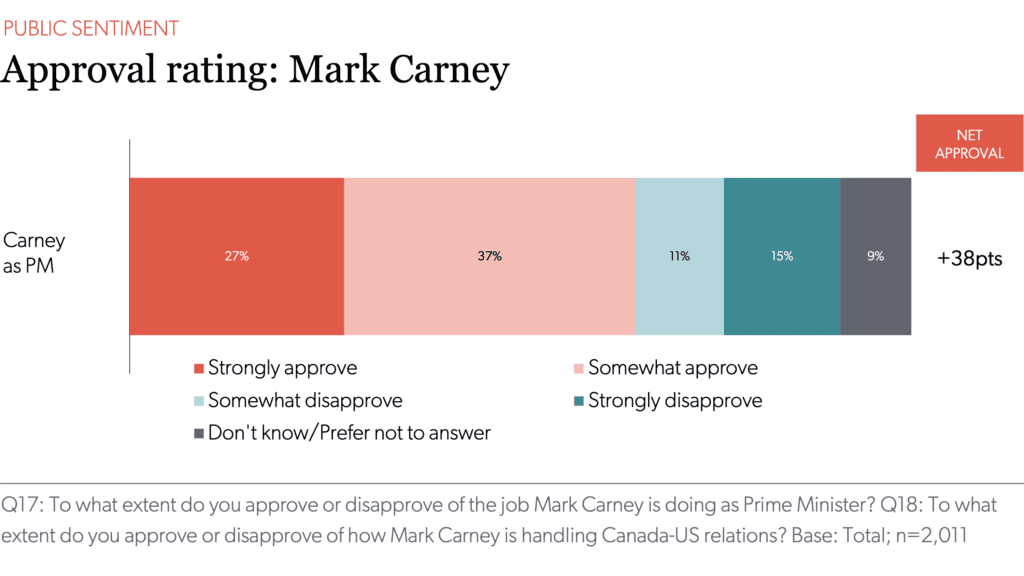
All of this leaves the Prime Minister and the Liberals in a commanding position as the House of Commons returns from its summer break. In addition to the continuing strong support of the public, the Liberals’ byelections wins extended the government’s majority. With the weakened position of Pierre Poilievre and the Conservatives, the House of Commons may be challenged to enforce accountability on the Liberals.
Six more federal by-elections are waiting to be called by the Prime Minister which will mean tests for all parties and their leaders:
- Saint-Hyacinthe-Bagot-Acton (Quebec / BQ)
- Rosemont-La Petite-Patrie (Quebec / NDP)
- Laurier-Sainte-Marie (Quebec / Liberal)
- Scarborough North (Ontario / Liberal)
- Brantford-Brant South (Ontario / Conservative)
- Yorkton-Melville (Saskatchewan / Conservative)
The Conservatives
The summer has not been kind to Pierre Poilievre.
According to Earnscliffe’s most recent poll on approval ratings for federal political leaders, just 28% of Canadians have a positive impression of Pierre Polievre, with a net approval rating of -29 points; Mark Carney holds a clear advantage over the Conservative leader in favourability.
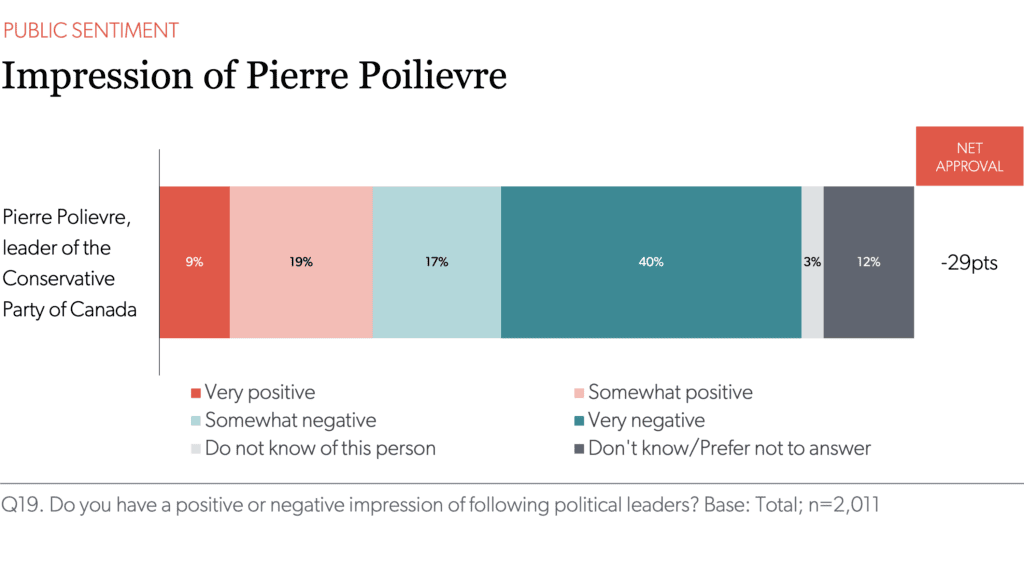
In addition:
- From a political-strategy perspective, the central problem is that the major issues currently dominating public debate, especially Canada-U.S. trade, investment, and economic sovereignty, all work to the benefit of Carney, leaving Poilievre searching for new points of contrast.
- Several Conservative MPs such as Jamil Jivani have continued to freelance on major issues, often making pro-MAGA comments or arguing among themselves, both of which embarrass the leader and party.
- There is increasing criticism of the growing influence of the network of right-wing influencers – the commentators, podcasters, YouTubers, and social media personalities – who operate outside the party structure and frequently embarrass it. T his contributes to the broader impression of a movement having a set of public arguments with itself, a theme highlighted in recent reporting on Conservative infighting.
The NDP
Effective September 7, the NDP appointed long-time party activist Francois Picard as its new National Director:
- Picard has extensive senior-level experience in the labour movement and in the party, working as a campaign director, campaign manager, and organizer for elections across Quebec, Alberta, Ontario and the Yukon.
The party has steadily built back its national polling numbers from 8% earlier this year to 11% in September, but leader Avi Lewis’s negatives keep getting worse. People don’t know who he is, and those that do, don’t like what they see. In addition, the Party had mixed results in the recent byelections:
- In Beaches–East York, the NDP finished second, with roughly 25.8% of the vote, a substantial improvement compared with its collapse in the 2025 federal election, though still well behind the victorious Liberals.
- In North Vancouver–Capilano, the NDP finished a distant fourth with about 3.1% of the vote.
In the upcoming byelection in Rosemont-La Petite-Patrie, previously held by Alexandre Boulerice, the NDP’s lone Quebec MP, will be a major challenge or the party.
Another central challenge for the NDP is that their leader remains largely unknown. According to a recent poll by Earnscliffe, three-in-ten (30%) Canadians do not know who Avi Lewis is, and a quarter (26%) do not offer an answer at all, suggesting that the party has much work to do to introduce him to the public.
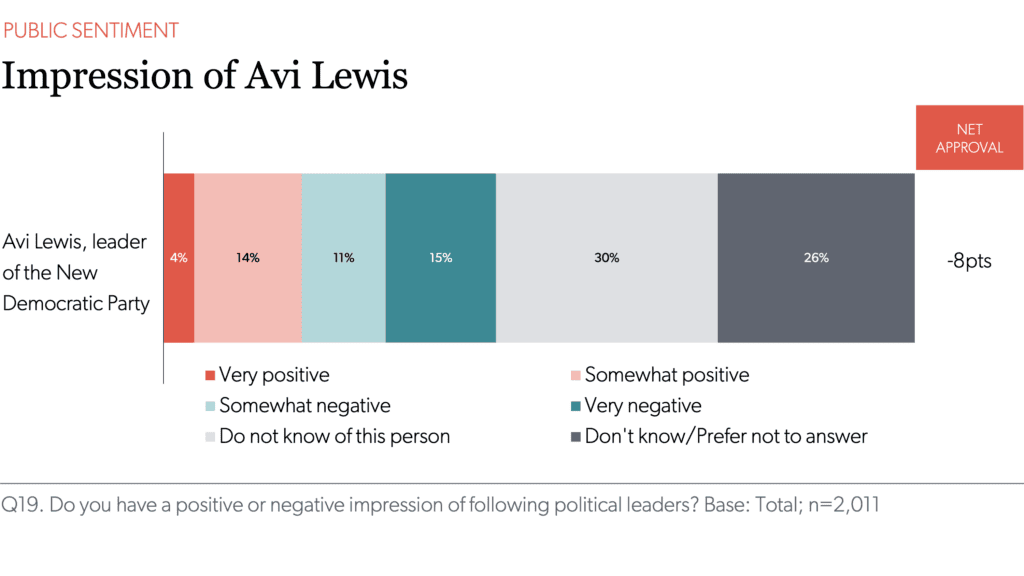
As the NDP held its recent caucus meeting in advance of the return of Parliament in Toronto, there were rumours that leader Avi Lewis is considering running for a seat in that city.
Upcoming political events
September 21: House of Commons returns to session
September 22: Senate returns to session
September 30: October 1: G20 Trade Ministers’ Meeting
October 5: Quebec provincial election
October 5: British Columbia return to session
October 19: Alberta referendum
October 26: Ontario Municipal Elections
October 26: Prime Minister and Premiers meet with First Nation leaders
October 27: Ontario Legislative Assembly return to session
November 21: Ontario Liberal Party Leadership Election results
The survey referenced above, conducted by Earnscliffe’s opinion research team, was in field from September 3- 7, 2026, and engaged a representative stratified sample of 2,011 respondents living in Canada aged 18 years or older (with an effective national sample size of 1,918) who are members of Leger’s LEO panel. Respondents had the option of completing the survey in French or English. For comparison purposes only, a probability sample of this size would have a margin of error of +/- 2.19 at a confidence level of 95%.
Results were weighted according to age, gender and region based on Census 2021 data to ensure a representative sample of the Canadian population.
Earnscliffe is a member of the Canadian Research Insights Council (CRIC), and this research was conducted in compliance with CRIC standards.
For more select findings from this research, please see the data tables or contact hmartin@earnscliffe.ca