

The Ontario Legislature wrapped up on June 2nd, two days earlier than expected. The session included just shy of 30-sitting days, while MPPs find themselves with more time than expected back home with the legislature now only coming back after the Ontario Municipal elections on October 26, which means the doors to the Queen’s Park will reopen on October 27th.
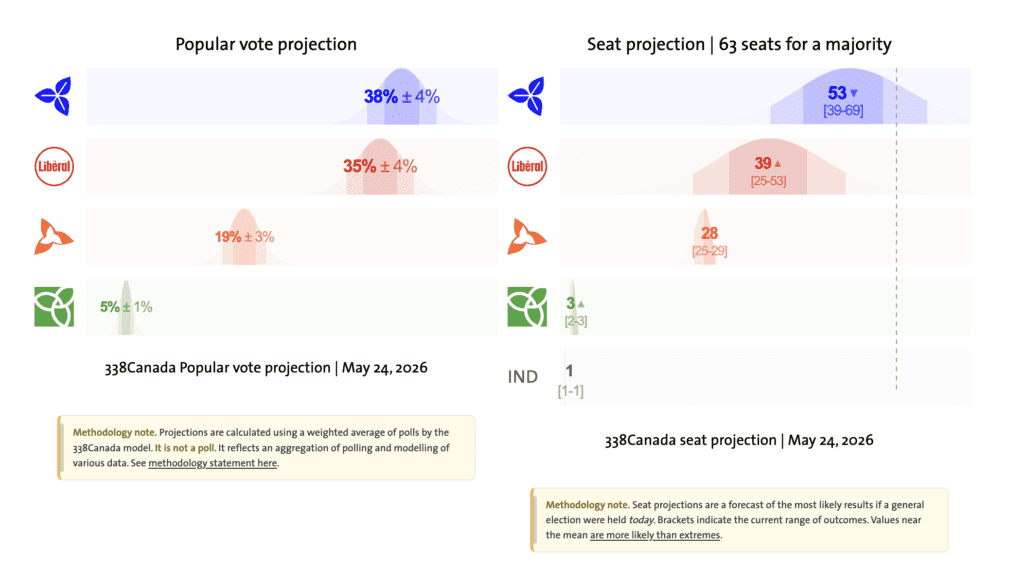
At Spring’s end, Premier Doug Ford and the Ontario Progressive Conservatives still hold a balance in public opinion polling, according to aggregated polling numbers which show the PCs with a three per cent lead over the Ontario Liberal Party at 38 per cent and 35 per cent respectively. Ontario’s Official Opposition Party, the ONDP, trail at 19 per cent. So, while the PCs still maintain a lead, this session has shown signs that the three-time majority government may be in for a more competitive political environment than they have seen in a long time.
The issues that carried the Ford government through past tough economic situations, like tariff and jobs positioning have seemingly been offset by controversies over Bill 5, government transparency and spending optics. This has allowed the Ontario Liberals to gain space and support even during leadership limbo and some internal skirmishes. Affordability and ethics concerns are areas where Liberals push, however they are still proving their readiness and won’t land on their new leader until Fall. The NDP retained a sharper opposition voice on labour, health, housing and Indigenous rights, yet still face risks of being squeezed by Liberal recovery. It remains to be seen how the selection of Avi Lewis as federal NDP leader affects Ontario NDP fortunes, with NDP in some provinces choosing to pull away from the federal party. Ontario politics remains Ford-led, but more competitive than in 2025.
The government’s session in review
Premier Doug Ford won the February 27, 2025, snap election on a tariff-fighting mandate, then governed around “Protect Ontario” themes: trade, infrastructure, housing, critical minerals, energy and manufacturing. The original core themes were still very much present throughout the session.
Premier Ford continued to make waves with a strong pro-development series of red tape reforms, many of which were broadly enabling with implementation details to follow in regulations. Directives on Buy Ontario Legislation (passed in the fall session) are still expected to roll out over the balance of the year. Other initiatives included Bill 5, aimed at streamlining mining and energy project approvals and a 2026 budget that focused on tariff protection, tax relief, housing rebates, infrastructure, manufacturing, critical minerals and business supports.
The 2026 budget leaned into tariff protection and growth: small-business tax cut from 3.2% to 2.2%, one-year HST relief on new homes under $1M, infrastructure spending, manufacturing supports, jail expansion and classroom-supply money for teachers. It was not without its critics however, with a projected $13.8B deficit and a delayed return to balance until 2028-29, as the government bets that stimulus can protect jobs and revenues.
There was some controversy over several government decisions including but not limited to special economic zones, environmental regulation changes, Freedom of Information (FOI) changes, an unusually long winter recess, Billy Bishop expansion, speed cameras, and the 2026 private-jet purchase and subsequent return. The plane and FOI items came in quick succession and did lead to some bumps in the road for the government. For a time, this led to some serious narrowing of the gap between the Ford PCs and the Ontario Liberals even under an interim leader.
As for Ontario’s role in the Canadian federation, Premier Ford and Prime Minister Carney have maintained a mostly pragmatic working relationship: housing, infrastructure, tariffs, critical minerals and “nation-building” projects align them. Their March 2026 housing deal showed cooperative federalism, even while the Premier keeps pressure on Ottawa to defend Ontario industry. By comparison Premier Ford’s relationship with federal Conservative leader Pierre Poilievre, while improving, is not as cooperative.
The look-ahead
Over the summer recess, Premier Ford and the Ontario PCs will likely use the long break before the legislature returns to govern from the road: touring ridings, announcing local infrastructure, health, roads, housing, mining and affordability measures, and keeping MPPs visible in their communities. The extended 21-week break lets the PCs focus on promoting their agenda directly.
With the upcoming CUSMA review, the Premier plans to dust off his Captain Canada gear and head south of the border to advocate against tariffs and for stronger economic partnerships between Canada and the United States. Premier Ford is set to co-host a business reception in Washington with American Ross Perot Jr., the Chair of the U.S. Chamber of Commerce. At the end of June, he will also travel to the 2026 Southeastern United States-Canada Provinces Conference in South Carolina and to the Western Governors’ Association in Utah to promote his Fortress Am-Can vision.
As-of the writing of this note, there is a possibility of at minimum some minor changes in cabinet.
In October when the legislature returns, expect renewed focus on tariffs/USMCA, jobs, housing implementation, Ring of Fire/special economic-zone regulations, infrastructure, affordability relief, and managing backlash on transparency, Indigenous consultation, health care and ethics. Premier Ford will be facing a Liberal party with a newly elected leader, this could mean different strategy and tactics to move the government’s agenda. That agenda, four months from now, will likely be built around economic protection, infrastructure delivery and targeted populist affordability measures. Expect a fall focused around: “build, protect, compete”: faster approvals, pro-worker tariff response, more infrastructure, and a more aggressive Ontario-first economic posture. Ontario has already previewed a defence industrial strategy, so fall could bring procurement, manufacturing and supply-chain announcements tied to federal defence spending.
Ontario Liberal Party
Despite continuing to be leaderless, the Liberals have enjoyed a recent spike in popularity. While the bump in polling is at least plausibly and partially attributable to a strong Carney-brand nationally, political observers across the province have turned their attention to the race to take the reins of the party, which is now beginning to take shape.
They will spend the summer months continuing their long search for a new leader, for the third time since 2010.
For the last several months, the expected shape of the race has hinged on the political fortunes (or misfortunes) of 2023 runner-up Nate Erskine-Smith. Once the presumed front-runner in the race, the MP for Beaches—East York attempted to use a vacancy in the neighboring riding of Scarborough Southwest as a steppingstone for his leadership ambitions, believing that if he were able to win a seat in the legislature, he’d be far better placed to win the leadership. His high stakes gamble failed to pay off, and he lost a hotly contested nomination to Ahsanul Hafiz by 19 votes on the second ballot. He has since said his intentions to seek provincial leadership are increasingly less likely.
With Erskine-Smith seemingly out, others have taken the opportunity to officially throw their hats into the ring:
- Navdeep Bains, former Trudeau-era federal cabinet minister
- Rob Cerjanec, MPP for Ajax
- Lee Fairclough, MPP for Etobicoke-Lakeshore and former hospital executive.
- Dylan Marando, a former political staffer
- Navdeep Bains and Lee Fairclough are seen as the leading contenders at the onset of the race.
Ontario NDP
Under Opposition Leader Marit Stiles, the ONDP structured much of its spring messaging around a five-part “Budget Report Card” that assessed whether the government’s 2026 Budget:
- Lowered the cost of rent and groceries;
- Improved health care and education;
- Built affordable housing;
- Created good jobs and opportunities; and
- Used public funds responsibly
The party positioned itself as a critic of the Ford government’s budget priorities, arguing that greater attention should be paid to lowering housing and living costs, strengthening health care and education services, and supporting workers and families facing ongoing economic pressures. The ONDP also placed particular emphasis on post-secondary affordability, youth opportunities, and concerns about staffing shortages and service levels across the public sector.
Heading into the summer, expect the ONDP to continue advancing a message centered on affordability, housing, health care, education, and economic security. Recent initiatives, including a proposed Youth Summer Jobs Program, signal an increased focus on youth employment and workforce development.
Politically, the party’s most immediate focus will be the upcoming Scarborough Southwest by-election, triggered by the resignation of former NDP MPP Doly Begum. It will be an important test of the party’s ability to retain support in a past NDP riding and maintain momentum as Official Opposition.
Relevant legislation moved by government
- Bill 114 — HST Relief Implementation Act (Residential Property Rebates), 2026
- Bill 110 — Building Billy Bishop Airport Act, 2026
- Bill 101 — Putting Student Achievement First Act, 2026
- Bill 100 — Better Regional Governance Act, 2026
- Bill 98 — Building Homes and Improving Transportation Infrastructure Act, 2026
- Bill 97 — Plan to Protect Ontario Act (Budget Measures) 2026
- Bill 75 — Keeping Criminals Behind Bars Act, 2026
- Bill 9 — Municipal Accountability Act, 2026
Noteworthy upcoming dates
- Ontario PC Party Ford Fest 2026 – June 19
- Southeastern United States-Canadian Provinces Conference (SEUS-CP) – South Carolina – June 21 – 23
- Energy Forum 2026 – June 23
- Council of the Federation Meeting – July 21 – 23
- Last Day to Submit OLP Leadership Nominations – July 31
- Canada Investment Summit – September 14 – 15
- Ontario Municipal Elections – October 26
- Return of the Ontario Legislature – October 26
- OLP Leader Elected – November 21