
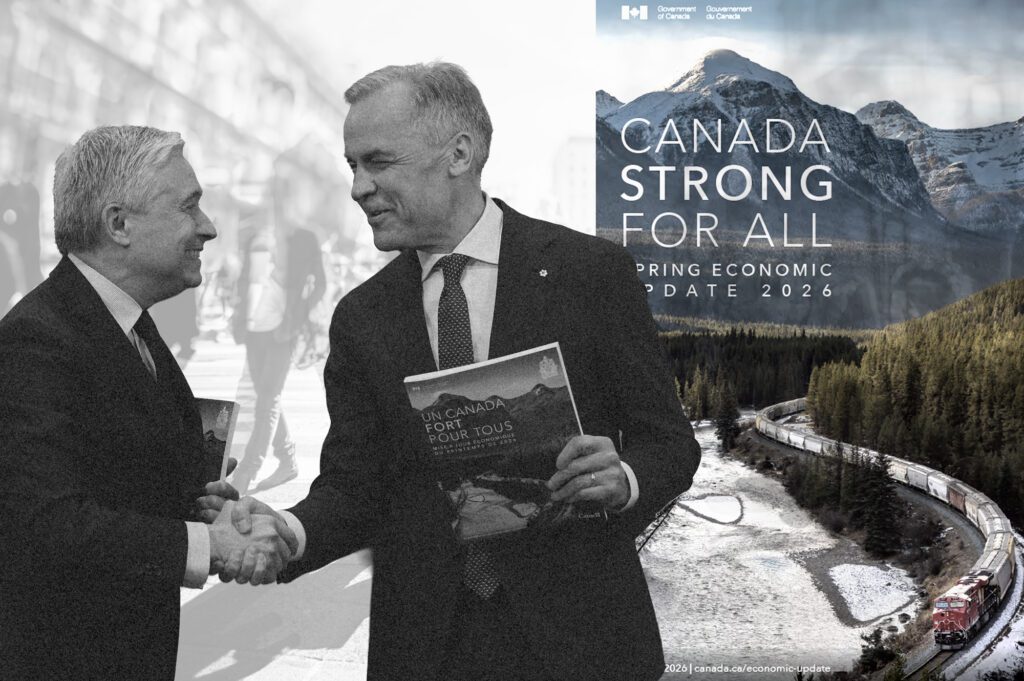
Today’s Spring Economic Update (SEU) comes amid a domestic and global climate of economic instability and uncertainty.
In the coming months, high-stakes negotiations will determine the future of trade with Canada’s largest economic partner. At the same time, the Middle East war has resulted in competing blockades of energy and commodity shipments, threatening a prolonged period disrupted supply chains and higher inflation for hard-pressed Canadians.
The Carney agenda
Over the past year, the federal government has been pursuing a set of multi-tracked policy objectives:
- Through its Canada Strong agenda, to build domestic economic sovereignty to reduce over-reliance and dependency on the United States.
- To streamline and coordinate federal and provincial review processes to enable faster decision-making for nation-building projects.
- To pursue and cement diversified trade and defence procurement relationships with friendly global powers.
- To provide support to the millions of Canadians facing the affordability crisis caused by persistent inflation and the rising cost of living.
Today’s update aims to keep up the pressure on implementing this ambitious agenda while communicating that while the results may not be evident in Canadian’s pocketbooks, longer-term progress on the strategic ambitions of the country is being made.
Affordability
As today’s update acknowledged, despite a better fiscal outlook, millions of Canadians grapple with an affordability crisis each day. While the urgency of monthly cost of living increases due to inflation has somewhat abated, surges in fuel and increases in food costs continue to plague household budgets. An Angus Reid poll released the day before the SEU reported that “Half (52%) of Canadians say that reducing the cost of living will be the biggest challenge for Carney and the Liberals over the next 12 months”.
This has led the Carney government to respond with several initiatives to help Canadians cope with inflation, but broadly-based support measures are hugely expensive. The Canada Groceries and Essentials Benefit (Enhanced GST Credit) announced this past January has an overall cost of $12.4 billion running to 2030-31, while this summer’s federal fuel excise tax exemption will cost the federal government $2.4 billion in uncollected taxes.
Today’s update offered little in the form of these large broad-based measures and opted for more incremental and targeted approach which saw a reduction in the Canadian Pension Plan contribution amounts from 9.9% to 9.5%, which will save Canadians (and their employers) who make $70,000 a year about $133. This has been well received on the surface by the business community and has the consent of the provinces. Additionally, the government has promised to streamline the disability tax credit for eligible Canadians.
Who builds Canada Strong?
With the government focusing the past year on streamlining and approving large national infrastructure projects, today’s SEU included the next phase of ensuring these projects get built. Minister Champagne announced the Team Canada Strong Strategy, which provides $6 billion over five years toward the skilled trades program, which expects to recruit, train and hire 80,000 to 100,000 new workers in the field. This not only looks to ensure Canada has the workers needed to facilitate the building of these national infrastructure projects but also locks-in the country’s skilled workforce to provide well paid jobs in the industrial future of the country.
Public vs private investment
Last December’s Budget 2025 sounded an alarm about the long-term weakness of Canadian business investment. It noted that, “Overall business investment within Canada has been flat over the past decade, while business investment in the U.S. has risen sharply.” The Budget also noted that many businesses have a risk-averse “mindset reinforced by structural impediments such as the regulatory environment, limited competition, and scale constraints.”
While the Carney government claims to be reforming how the public sector operates, initiatives such as Major Projects Office and the Defence Investment Agency are “work arounds” and do little to address the underlying bureaucratic hurdles and impediments to faster decision-making. TC Energy CEO Francois Poirier recently argued that regulatory reform should designated a “major project”. Unfortunately, today’s update contained no such commitment. This does not take away from the utility of these major initiatives, including the Defence Investment Agency which the SEU proposes to stand-up as a standalone agency with a dedicated minister. While these changes may not be moving fast enough for some, the outcomes they hope to produce likely remain lightyears ahead of purely structural bureaucratic change.
On public investment, today’s update provided few additional details on the federal plans to create a “Sovereign Wealth Fund” which was announced yesterday. Details on its purposes and objectives will emerge over the coming months through a public and stakeholder consultation process. Already the concept has attracted some criticism, beginning with its financing through borrowing and additional national debt. As Conservative leader Pierre Poiiievre asked, “If a project has a business case, why would the government need to fund it? If it doesn’t have a business case, why would the government want to fund it?”
At the end of the day?
Today’s update does not stray far from Budget 2025’s characterization as a technocratic exercise, but it remains cautiously optimistic about the path it sets for the country. While the economy appears more resilient than expected in the face of U.S. tariffs and uncertain global conditions, the government seems to be playing a longer game. With its new majority in the House, the government may have more confidence and latitude to push forward with their infrastructure plans and secure new trade agreements, while the visible benefits for Canadians come to light.
Key numbers
As foreshadowed by the Prime Minister during his announcement the day before the SEU, the fiscal prospects for the country are slightly improved compared to last November’s budget. The 2025-26 deficit was revised down to be $66.9 billion, which is $11.5 billion lower than previously projected. Which is good news and can be largely attributed to better-than-expected growth late last year as well as the surge in oil prices due to the war in Iran. This lower projection also includes measures taken by the government since the fall budget. Still, the government has decided to reinvest this revenue windfall, as the SEU includes $54 billion in new spending over six years since the November budget, which explains why the fiscal projection path remains little altered. Deficit spending is expected to come in $100 – $400 million below Budget 2025 projects each year until 2029-30.
Debt as a percentage of GDP was highlighted in the SEU as remaining relatively stable over the forecast period, being 41.1 per cent in 2025-26, 41.5 per cent in 2026-27 and then continuing to rise slightly until peaking at 41.9 per cent in 2028-29. The SEU also predicts the government will reach its target of balancing operating expenses with revenues by 2028-29 and through 2030-31. This projection shows budgetary revenues will steadily grow and outpace operating costs, increasing consistently from $511.5 billion in 2025-26 to $613.7 billion in 2030-31.
While the overall fiscal picture is better than thought nearly six months ago, it also cannot be ignored that the government continues to feel the same strain Canadians do as higher borrowing costs dig into revenues. Public debt charges are expected to steadily rise from $58.7 billion in 2026-27, to $80.9 billion in 2030-31. This puts debt servicing in the top three expenditures—depending on how defence spending is accounted—the government must manage, only surpassed by benefits to elderly Canadians.
Key initiatives
The Canada Strong Fund: Canada’s Sovereign Wealth Fund
- $25 billion over 3 years, on a cash basis, to seed the Canada Strong Fund.
The Team Canada Strong Strategy:
- $2 billion over five years, starting in 2026-27, and $262 million ongoing, to increase the number of young people in the skilled trades.
- $331 million over five years, starting in 2026-27, and $18 million ongoing to boost and modernise apprenticeship training to streamline getting a Red Seal.
- $3.4 billion over five years, starting in 2026-27, and $468 million ongoing to address the challenges that can stop apprentices from completing their training.
- $250 million over five years, starting in 2026-27, and $45 million ongoing, to expand Canada’s skilled trades training capacity through the CAF.
Standing up the Defence Investment Agency as a standalone entity:
- $103.8 million over five years, starting in 2026-27, and $22.3 million ongoing to establish and operate the DIA.
- Introduce enabling legislation to establish the DIA as a stand-alone entity and legislative amendments to the Defence Production Act to provide the DIA with expanded authorities needed to operate.
Reducing Canada Pension Plan contribution rates from 9.9 per cent to 9.5 per cent, effective January 1, 2027.
Launching a Whole-of-Government Competition Plan to strengthen productivity and affordability by ensuring that competition is prioritised throughout the federal government’s policies.
Implementing Accelerated Capital Cost Allowance Rates for Low-Carbon Liquefied Natural Gas Facilities.
Making the Employee Ownership Tax Credit permanent.
$957.8 million over five years, for the Small Craft Harbours Program.