Against the backdrop of an unprecedented energy crisis driven by the ongoing conflict in the Strait of Hormuz, energy-constrained countries are exploring ways to diversify supply. In Canada, this has renewed discussion about the country’s role as an energy exporter, including the possibility of building a new pipeline to the West Coast—a prospective project with a long and contested history. Public opinion polling from late 2025 indicates majority support for such a project: 60% nationally and 54% in British Columbia support the idea of an oil pipeline from Alberta to the B.C. coast. A quarter (25%) are opposed nationally, while 37% in B.C. say the same.
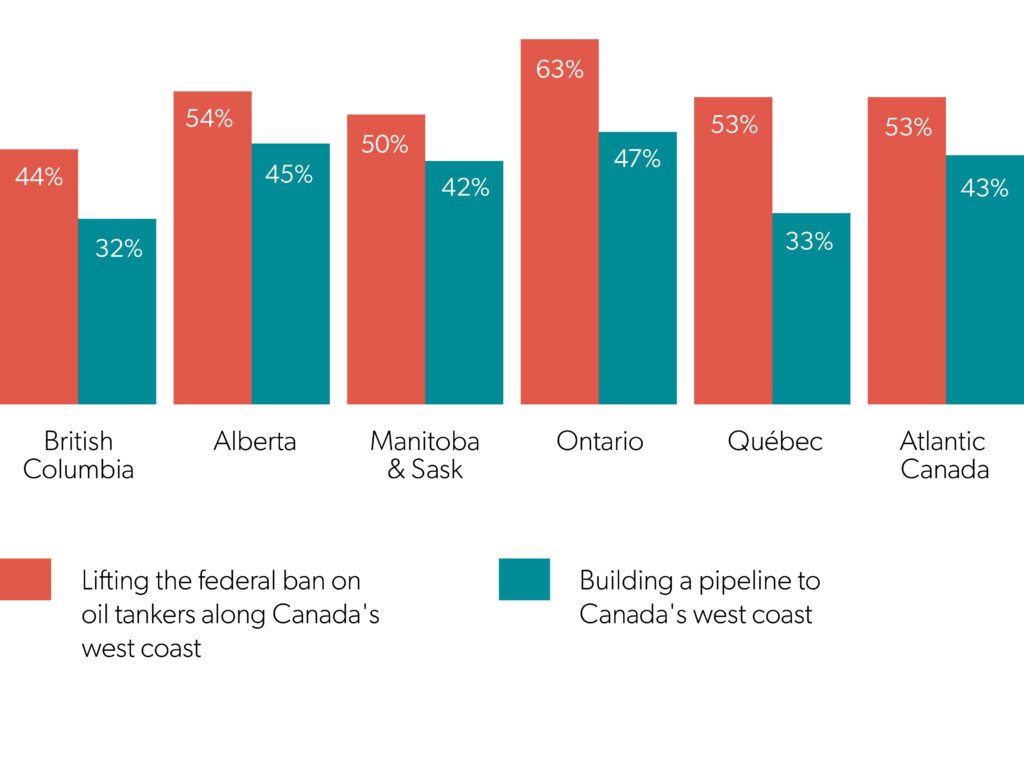
Given that any such pipeline would cross the lands of numerous Indigenous nations, understanding Indigenous perspectives is essential. Data from Earnscliffe’s most recent wave of Indigenous Insights – the largest and longest-running study of Indigenous opinion in Canada – fielded in February of this year find that 42% of Indigenous respondents nationally support and 34% oppose building a pipeline from Alberta to the B.C. coast. Support is lower in British Columbia, where only 30% of Indigenous respondents express support and 40% stand opposed.
Another key consideration is the federal ban on oil tankers along Canada’s West Coast, which has implications for the project’s economic feasibility. On this question, Indigenous opinion is divided with 32% of respondents nationally supporting lifting the ban, while 34% oppose it. Among Indigenous respondents in British Columbia, support is once again lower, with 20% in favour of lifting the ban and 46% opposed.
Figure 1: To what extent do you support or oppose each of the following?
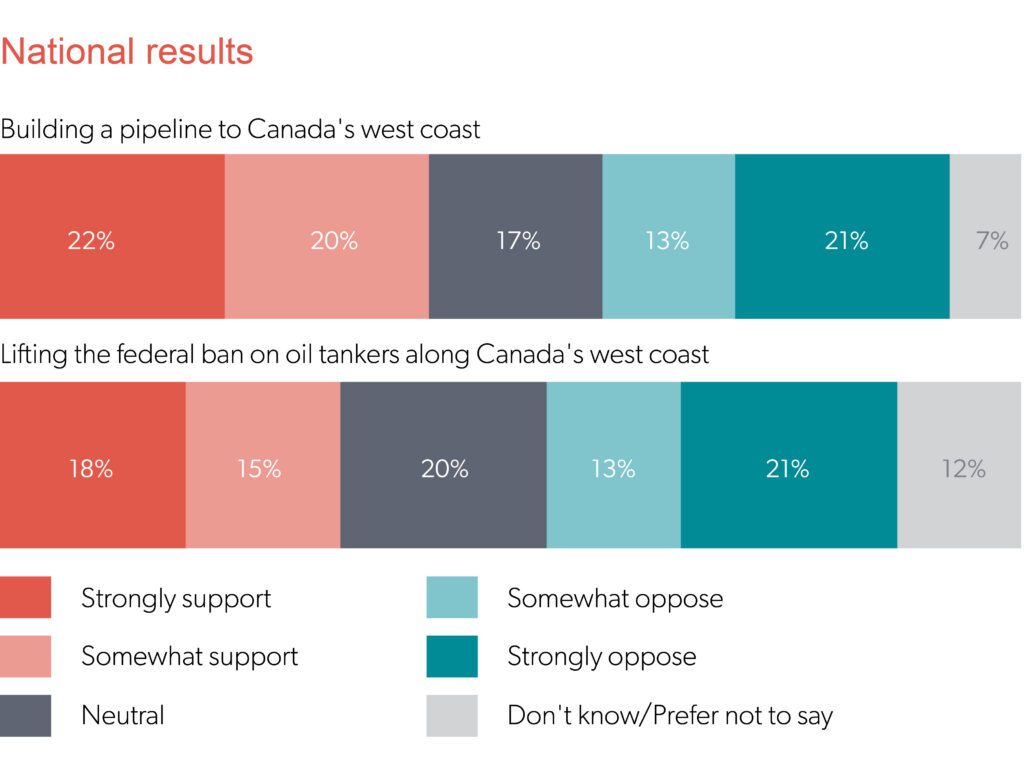
The opinion landscape shifts, however, when the possibility of Indigenous ownership is introduced. Immediately following these initial questions, Indigenous respondents were asked whether they would support or oppose both the pipeline and lifting the tanker ban if the Indigenous nations whose lands the pipeline would cross were given an ownership stake in the project. Under these conditions, national support for building a pipeline increases to 54%, while in British Columbia it rises to 44%. Support for lifting the tanker ban also increases: nationally, more respondents support than oppose lifting it (41% vs. 30%). In British Columbia, support rises to 32% among Indigenous respondents.
Figure 2: And what if Indigenous nations whose land a pipeline would cross were given an ownership stake in the project, would you support or oppose the following?
These findings reflect something broader than a debate about any single pipeline. Indigenous opinion is not a monolithic bloc. Each nation is a distinct economic actor with its own trade exposures, diversification interests, and calculus about what kinds of projects serve their communities.
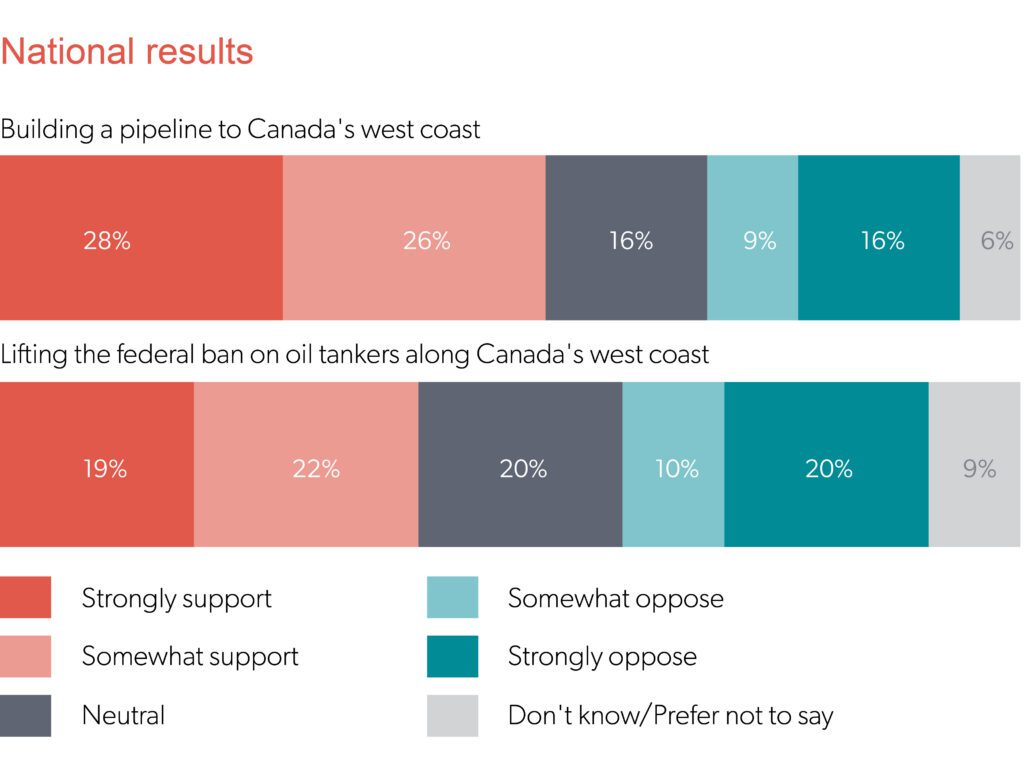
To this point, data from earlier waves of Indigenous Insights show that many Indigenous peoples view their own economic futures as vulnerable to trade disruption, including U.S. tariffs. Seen through this lens, diversification can become a shared, and not necessarily a competing, interest.
Figure 3: The United States recently imposed tariffs on some products from Canada. Based on what you’ve seen, heard, or experienced, what kind of impact do you think these tariffs are having on each of the following:
Ultimately, the increase in support associated with Indigenous ownership in major projects suggests that approval and participation are not separate questions – and that how the latter is structured has significant bearing on the former.
These findings suggest that viewing affected nations as partners with a vested interest in the pipeline’s future as a starting point may be the most productive framework for Indigenous engagement with resource development. On that basis, the data point to meaningful common ground: one most likely to emerge not after the terms of a project are set, but as they are being designed and governed from the outset.
Findings from figures 1 and 2 are from the Winter 2026 wave of Earnscliffe’s Indigenous Insights study, which was in field from February 9 to 20, 2026. Findings from figure 3 are from the Spring 2025 wave of Earnscliffe’s Indigenous Insights study, which was in field from May 14 to June 3, 2025. Earnscliffe’s Indigenous Insights is a syndicated, quarterly research study, that captures the views of First Nations, Métis, and Inuit peoples across Canada. Each quarter, 500 interviews are conducted via online survey. It is designed to be representative of the Indigenous population in Canada as we understand it from Statistics Canada.
Appendix
To what extent do you support or oppose the following?
Those who say they strongly or somewhat support
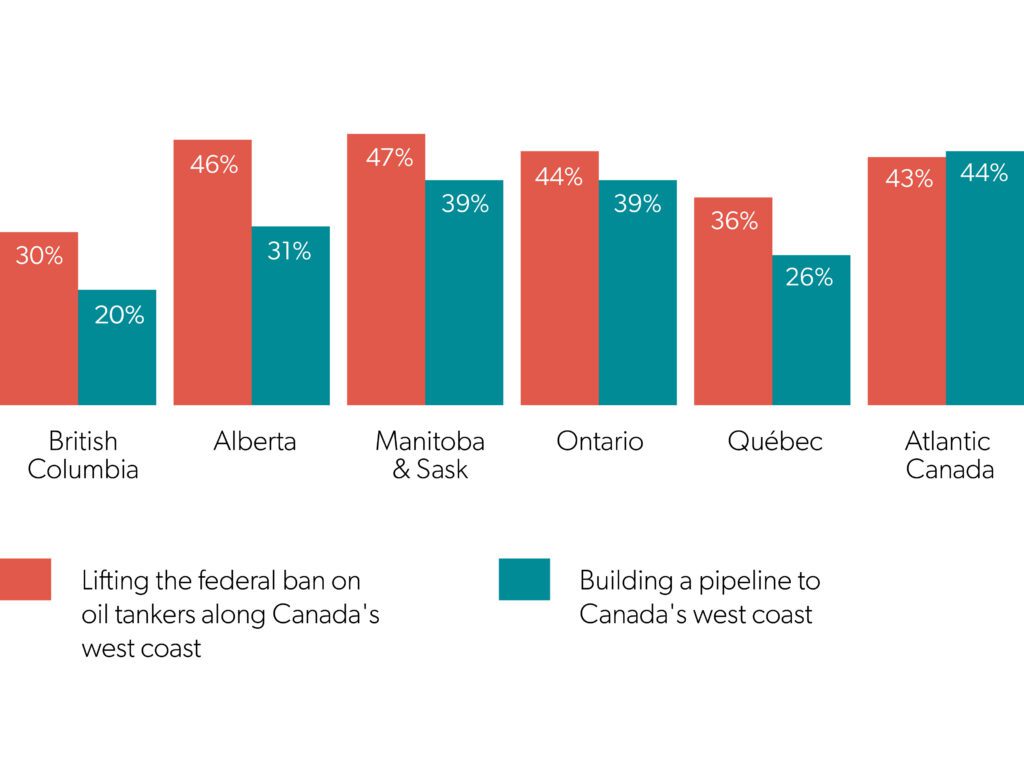
And what if Indigenous nations whose land a pipeline would cross were given an ownership stake in the project, would you support or oppose the following?
Those who strongly or somewhat support each