
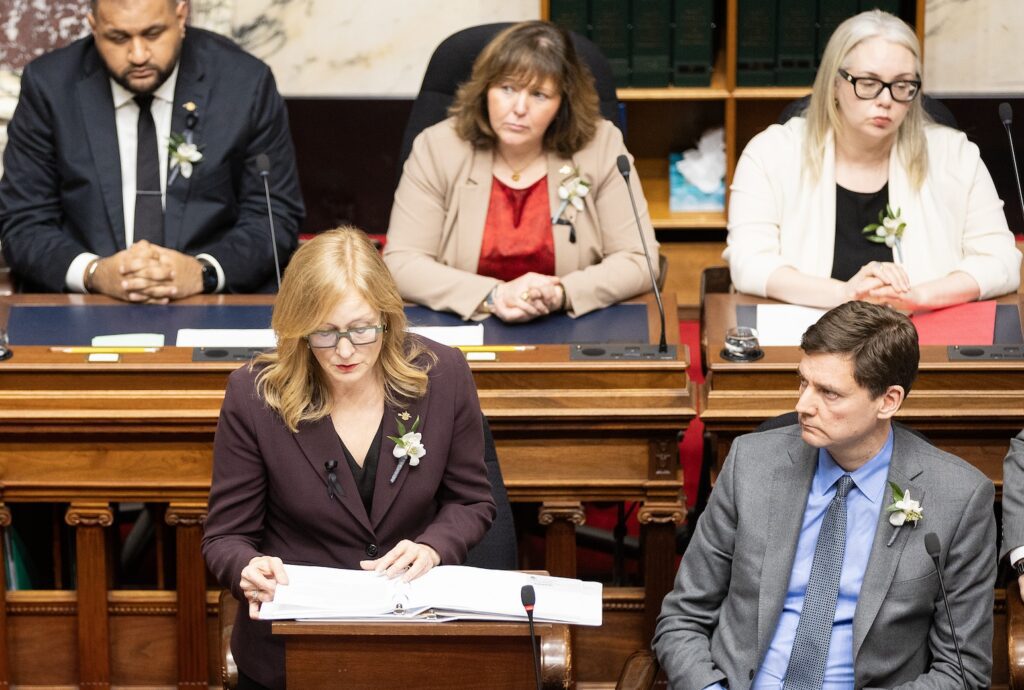
Today British Columbia Finance Minister Brenda Bailey tabled Budget 2026: Securing B.C.’s Future.
Minister Bailey set the stage for tough choices that will need to be made in light of the economic challenges over the past year, including U.S. tariffs, volatile commodity markets, a cooling housing market, and declining population growth. Budget 2026 is an exercise in balancing expectations in tough economic times, from an NDP government elected in the fall of 2024 due to its bold affordability agenda.
In Minister Bailey’s own words:
Over the past eight years we have built schools, hospitals and invested in the services British Columbians rely on every day. Our investments have allowed us to enter these uncertain times from a position of strength, but we need to be realistic about the difficult financial situation we face as a province. We are choosing to safeguard what we’ve built, while growing our economy to secure good jobs and economic prosperity for people and families.
Charting an uncertain future
In her opening remarks, Minister Bailey emphasized that this is not an austerity budget. Capital spending is still at record levels. B.C. is continuing to build roads, bridges, dams, rapid transit and transmission lines with the goal of fast-tracking major projects. All of this culminates into a $13.3 billion deficit is forecasted for the 2026/2027 fiscal year, up from an initially forecasted $9.6 billion for this year. This is the highest deficit spending in the province’s history.
However, Minister Bailey also pointed out that Budget 2026 reflects the government’s goal of making careful choices now to avoid more difficult ones later. These included reducing the public sector by 15,000 full-time jobs. These cuts will make some public servants nervous but were not quite deep enough to reduce deficit spending below 2024-25 levels. Minister Bailey and Premier Eby will face criticism for B.C.’s total debt load, which will exceed $230 billion by 2029 with the debt-to-GDP ratio exceeding 37%. For context, these relative debt levels fall below Quebec’s, Ontario’s and Government of Canada’s.
In her opening remarks, Minister Bailey said that her government is no longer able to focus on what they want to do but instead is focusing on what it must do. The Minister reiterated that the focus on education, health, and public safety was non-negotiable for British Columbians and this is why Budget 2026 included investments in these sectors.
This will be important context for stakeholders as they speak to government, as they will need to position themselves, their projects or products as a ‘must’ for British Columbians. Failing to do so risks being out of alignment with a government trying thread the needle between a difficult economic picture, prudent fiscal management and increasing demands on public services.
Our top 10 takeaways from Budget 2026
1. Continued cuts to the B.C. Public Service
Last year’s budget initiated the B.C. Government’s Expenditure Management and Efficiency Review, which began work to set initial savings targets, expenditure control and program review. These initial measures are expected to result in savings of $400 million this year; however, in Budget 2026, the rubber hit the road. It was announced that the B.C. public service will shrink by 15,000 full- time employees over the next three years, representing a 3.4% reduction. These staff reductions, along with other measures, are intended to save the province $1.15 billion in 2026-27, $2 billion in 2027-28 and $3.2 billion in 2028-29 — nearly $6.4 billion of savings over three years.
2. A challenging economic outlook
Budget 2026 projects a $13.3 billion deficit for 2026-27, but is projected to decline to $12.2 billion in 2027-28 and $11.4 billion in 2028-29. B.C. is expected to see slower economic growth, with real GDP growth projected at 1.3% in 2026 and 1.8% in 2027 due to ongoing economic and international uncertainty. Budget 2026 does forecast stronger growth in the medium term (2028-2030), averaging 2.1% annually.
Budget 2026 shows a $1.6 billion reduction in deficit spending for 2025-26. This is mainly due to higher revenue from corporate and personal income tax and lower spending for refundable tax credits. This small bit of good news builds credibility for the government as they navigate these troubled economic times. Debt servicing has increased, taking up nearly six cents for every dollar of revenue in the coming year. This is worth keeping an eye on, as even the Finance Minister said she hopes the bond rating agencies will recognize the structural changes in spending and revenue the government is introducing that are meant to improve the province’s financial footing in the years to come. This is in hopes to stave off any additional credit downgrades which further increase the cost of borrowing.
Interestingly, year over year, trade remained unchanged. There was a 2.7% reduction in trade to the United States, but that was offset by a 3% increase to non-U.S. trading partners. This stability is likely short lived, and the question remains whether efforts to diversify BC’s trading partners will offset the decline in trade with the United States.
3. B.C. is increasing revenue in the medium term
The province’s personal income tax rate will increase by 0.6 per cent on the first $50,000 of taxable income for 2026. This, along with forecasted increases in natural resource revenue, has led to a modest 0.5% increase in government revenues from 2025-26 to 2026-27. By 2027-28 revenue is expected to increase by $3.1 billion and another $3.2 billion by 2028-29. Revenue from the Natural Resource sector remains the largest driver of funds for the government with projects expected to come online in the coming years.
Minister Bailey also announced the PST tax base will be expanded to include professional services, which is consistent with other provinces. The 7% provincial sales tax will now apply to professional services such as accounting and architecture. That measure will bring in about $260million in the first year and will rise to more than half a billion dollars in tax revenue in year two of the fiscal plan. The speculation and vacancy tax will increase from 3% to 4% and the school tax (the property tax on high-value homes) will also be increased.
4. Capital investment will be managed through sequencing
In response to the tripling of taxpayer-supported capital investments tripling since 2017, the BC NDP included a capital moderation plan in Budget 2026. The budget reduces capital investment by $8.2 billion over three years compared to the Budget 2025 forecast. These expenditures will peak in 2026-27 as a result of projects now in or wrapping up initial stages of construction. Lastly, Minister Bailey cited this sequencing as a strategy to avoid the situation where the province is competing against itself, particularly if too many projects are underway simultaneously.
5. Education sees continued investment at all levels
Early childhood education is not seeing the cuts initially expected, likely thanks to the hard work of advocates and former MLAs in the sector. The 2026 budget includes:
- $330 million over three years to support and stabilize the ChildCareBC program.
- $634 million in K-12 funding over the next three years. The funding will be aimed at supporting teachers, student services and inclusive learning.
- $167 million for the Classroom Enhancement Fund, which includes additional educators, special education teachers, and teacher psychologists/counsellors. This will also include $6 million for First Nations Reciprocal Tuition, related to students attending First Nation schools.
- $4.4 billion total capital spending over three years for post-secondary education throughout the province. A significant portion of this funding comes from external sources such as foundations, donations, institutions, and federal programs.
6. Healthcare system prioritized, with privatization ruled out
In her budget speech, Minister Bailey made it very clear that privatization is not an option in B.C. Instead, the government’s emphasis is on reforming care, not cutting or privatizing it. The government has already identified more than $60 million for reinvestment by eliminating over 1,100 planned positions. Budget 2026 includes:
- A $2.2 billion investment over three years in targeted federal funding. This will see $447 million for Aging with Dignity, $653 million to expand public coverage for diabetes and hormone replacement therapy, and finally $1.1 billion over three years for the extension of the Working together to Improve Health Care for Canadians agreement. $131 million in new funding for mental health and addiction treatment. The 2026 budget will fund 3,785 treatment and recovery beds, and 19 Foundry spaces for those on the road of recovery, which forms part of the government’s response to the ongoing opioid crisis.
The Minister spoke at length to the value and presence of the B.C. senior population. Many Canadians choose to live out their retirements in B.C., which disproportionately effects the financials of senior care in the province.
7. Community-centered public safety continues to come first
Consistent with most B.C. municipalities, the B.C. Government is strongly focused on public safety. Budget 2026 outlines:
- A $139 million investment over three years in community-specific safety supports. This funding will support the recruitment and retention of sheriffs, Crown counsel, the judiciary, legal aid, and BC Prosecution Service.
- $16 million over the next two years will be used to establish the Chronic Property Offending Intervention Initiative (CPOII), whichtakes reoffenders and connects them directly with services that assist them in finding a lawful way forward. This program has been advocated for at length by municipalities, and has been piloted in Nelson, Kelowna, and Nanaimo. This funding will allow its expansion province wide.
8. Continuing as partners in sovereignty
Budget 2026 allocates $400 million for the new B.C. Strategic Investments Special Account that will allow the province to capitalize on federal funding opportunities as it invests billions of dollars to secure Canada’s sovereignty. The account will be used to attract investments in clean energy, value-added forestry, manufacturing, mining, life sciences, AI, quantum computing, maritime industries, aerospace and clean technology. The government also states they will continue to work with provincial partners to continue removing provincial trade barriers.
9. Government hears the importance of collaborating on B.C.’s natural resources
Minister Bailey stated in her speech that a message they continuously hear is that growing economies need B.C. energy. As such, the government committed to continuing to work collaboratively on responsible resource allocation, job creation, and moving LNG projects forward in collaboration with First Nations. She also referred to continued investments in mineral exploration, and addressing capacity needs in the permitting system and slashing the permitting backlog.
Budget 2026 commits to processing mineral exploration permits within 40 to 140 days, and has added a new escalation process for cases that beyond the deadline.
10. Continued support for B.C.’s struggling forestry sector
It’s no secret that B.C.’s forestry sector is struggling. Mill closures have continued to impact forestry-dependent communities. In 2025/26, the BC Government will provide $50 million of new and reallocated federal funding to support the sector and protect jobs:
- The BC First Nations Forestry Council is receiving $5 million to continue the Indigenous Forestry Scholarship program.
- $5 million is allocated to the Wildfire Reduction Equipment Support Trust to help logging contractors purchase specialized equipment to recover timber supply affected by fire.
- The Forestry Service Providers Compensation Fund is receiving $5 million to provide relief for contractors in the event of their tenure holder’s insolvency.
- B.C.’s FireSmart Community Funding and Supports program will receive $15 million to recapitalize.
- The Northern Development Initiative Trust will receive $20 million to support operators affected by softwood lumber tariffs.
Opposition responses
BC Conservative Party
Everyone thinks our revenues have slumped, and yes, our revenue has slowed, but they are still collecting record dollar figures off every taxpayer in British Columbia, and still running a record deficit… All they have done is spend, spend, spend, despite the fact that revenue was going up.
– Peter Milobar, Finance Critic, BC Conservative Party
After 10 years of NDP mismanagement, this budget is an assault on seniors, working families, and the small businesses that drive our economy. The NDP have turned their back on the people working hardest to make ends meet and the seniors who built this province.
– Peter Milobar, Finance Critic, BC Conservative Party
BC Green Party
British Columbia needs a budget focused on the health of people and communities, not one that ties the province’s prosperity to LNG expansion and fossil fuel dependency. The BC NDP’s key financial strategy — Look West — looks lost.
– Rob Botterell, Finance Critic, BC Green Party
The BC Greens have continuously advocating for increased taxes on British Columbias 1%, this budget however highlighted a tax increase to a lower tax bracket.
BC business community
On behalf of thousands of businesses across the Lower Mainland, the Greater Vancouver Board of Trade (GVBOT) has issued a letter grade of D for the 2026-27 provincial budget. Senior GVBOT staff assessed the budget based on three core criteria: Fiscal Management, Economic Growth and Competitiveness.
– Greater Vancouver Board of Trade Provincial Budget Report Card 2026 (link)
B.C.’s finances have unraveled at a breathtaking speed over recent years as spending growth has far outpaced revenue growth. Households and businesses also face around $4 billion in tax hikes over three years to try to plug the fiscal hole in a further blow to private sector economic activity.
– David Williams, Vice President of Policy, BCBC
More information
For a full breakdown of Budget 2026: