
Welcome back!
The Ontario legislature returned Tuesday after a 21-week break. Members of the Legislature were delayed in their return to allow for the Ontario municipal elections to wrap up on October 26. The legislature has 23 possible sitting days on the calendar before it wraps up for the holidays, which will make for a mad dash at Queen’s Park in the coming weeks.
The PC Government of Premier Doug Ford was nearly able to clear their agenda of legislation at the end of the last sitting, aside from bills 105 & 119, and arrives back with a mostly clear slate to start from. The challenges the government faces this fall compared to the spring however remain somewhat the same: Canada-U.S. relations and the outsized affect the trade war has had on the province, as well as continued cost of living and economic development concerns.
Level-setting
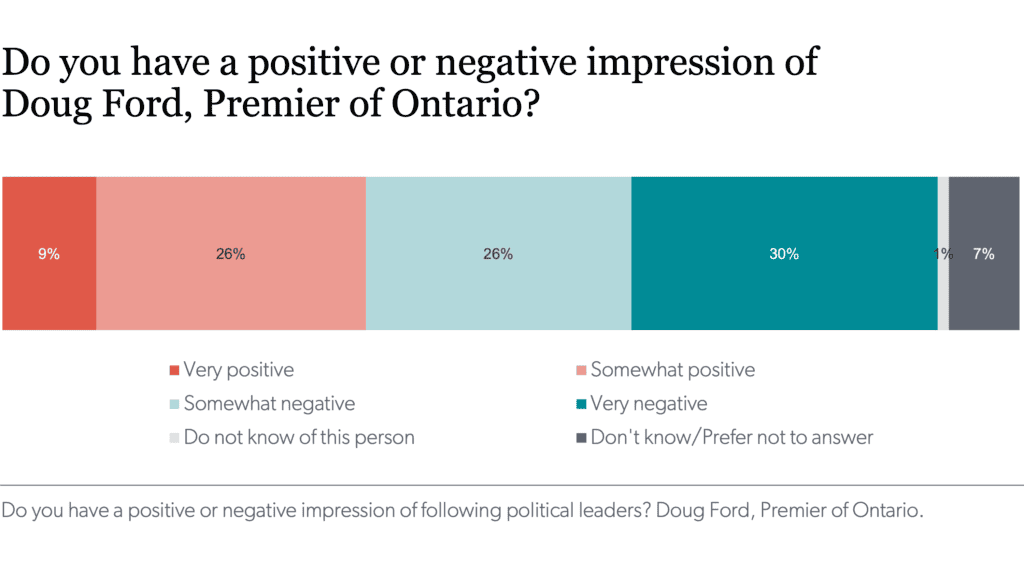
Recent Earnscliffe polling suggests that Premier Ford and his government head into the fall session facing some significant challenges, but perhaps in a slightly stronger position than when the legislature rose. While the Premier remains relatively unpopular, his standing with Ontarians has improved marginally compared to the spring. Among Ontarians surveyed by Earnscliffe earlier this fall as part of a national study, just over half (56%) have a negative view of the premier, compared to 36% with a positive view for a net -20. In May, the gap between approval and disapproval of the Premier sat at -27 points.
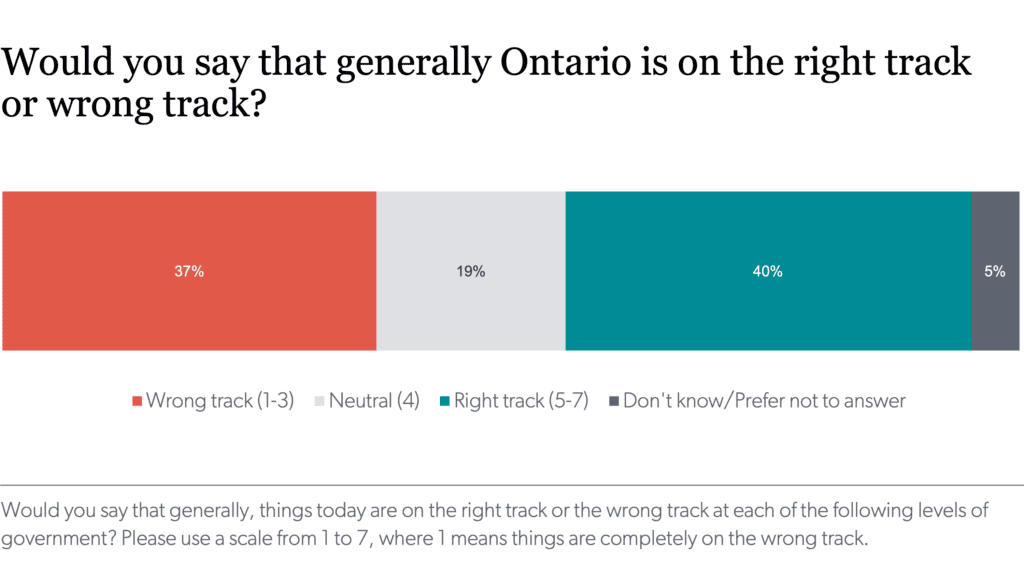
When it comes to the government’s performance, Ontarians are divided: 40% say their provincial government is on the right track, 37% say it is on the wrong track, and one-in-five (19%) are neutral. Polling aggregator 338Canada rates the Progressive Conservatives’ chances of forming government again, were an election held today, at 93%.
While there are obvious challenges facing this government wrapping up its eighth year in power, the outlook could be worse. An extended summer out of the legislature, coupled with Premier Ford’s approach to Canada-U.S. issues, may have dampened criticism. However, it is important to remember that the polls are only ever a snapshot in time, and much could change over the course of the next few months to shift the public’s assessment of the Premier and his government. For one, the Ontario Liberals will elect a new leader in November. It remains to be seen whether they will be able to make an effective case to Ontarians that it is time for a change in leadership.
The Government’s fall reset and looking ahead
From June through October, Premier Doug Ford’s central priority has been protecting Ontario’s economy against U.S. tariffs through business assistance, manufacturing investment and accelerated economic development. Nuclear expansion and the Ring of Fire underpin his longer-term competitiveness agenda. Through December, expect continued attention to infrastructure investments, housing affordability, health-care capacity and worker supports. The political objective is to demonstrate economic protection while containing dissatisfaction with public services.
September’s shuffle produced a 37-member cabinet, including eight associate ministers. Peter Bethlenfalvy’s Finance role provides fiscal continuity; Vic Fedeli’s continuing in the economic-development portfolio preserves investor relationships; Stephen Lecce’s Energy and Mines responsibilities connect electricity supply with industrial growth. Sylvia Jones anchors Health, while Paul Calandra brings political management experience to Education. Kinga Surma was promoted to Treasury Board, and David Piccini shifted from Labour to Infrastructure. New portfolios covering AI adoption and energy-intensive industries reinforce the competitiveness message.
Among parliamentary assistants, Tyler Allsopp, Jess Dixon and Monica Ciriello merit watching. Their assignments in economic development, education and the Attorney General’s portfolio provide exposure to consequential files and signal some legacy planning having them understudy more senior ministers. Anthony Leardi’s deputy House Leader responsibilities also signal Ford’s trust in Leardi. Stan Cho, recently removed from cabinet, was selected as Parliamentary Secretary to the Education Minister.
Relations with Prime Minister Mark Carney had been pragmatic but have become more strained at times. Ottawa’s rejection of the Billy Bishop airport expansion strained relations with Ford, whose caucus subsequently challenged Carney’s Alto high speed rail project. Reports suggested a reciprocal support deal, but Carney denied promising airport approval, leaving infrastructure cooperation politically fraught. The October 21 $8.7-billion industrial-support announcement demonstrates cooperation on steel, autos and economic resilience.
Major changes in the Premier’s Office were made back in March when Travis Kann replaced Patrick Sackville as chief of staff. Since then, the re-organizing of the Premier’s staff and in particular policy staff has intensified. This fall, Michael Klimuntowski returned to Ford’s office as deputy chief of staff for policy and delivery, while Giancarlo Da-Ré and Kevin Lynch departed. Across ministers’ offices, the September cabinet shuffle triggered successive chief-of-staff changes, including Ramneek Bala’s promotion to lead Vic Fedeli’s office.
For 2027, expect industrial diversification, nuclear investment, and more rollout of long-anticipated regulations to accompany already-passed bills. There will be pressure to show housing and health results. Ford’s agenda will likely centre on protecting jobs from U.S. tariffs through industrial support and Buy Ontario procurement. Expect faster mining approvals and Ring of Fire roads.
A new Liberal leader on November 21 could consolidate opposition support and sharpen scrutiny of the Ford government. Expect early PC attacks defining the winner before momentum builds. Stephen Lecce has labelled Navdeep Bains “Trudeau 2.0.”
What’s new with the Ontario NDP (ONDP)
The Ontario NDP returns to the Legislature with renewed momentum following its victory in the Scarborough Southwest by-election and strong performance in other key battleground ridings. Under Marit Stiles, the Official Opposition is expected to pursue a dual-track strategy: advancing proposals focused on affordability, health care, and housing while aggressively holding the Ford government accountable on ethics, spending, and governance issues. Expect the ONDP to focus this session on lowering costs, reducing health care wait times, and building more affordable housing for Ontarians.
The Ontario NDP is also expected to sharpen its economic narrative around job losses and industrial competitiveness, particularly in the steel and automotive sectors. Party officials have argued that the government has failed to adequately respond to layoffs and economic uncertainty affecting Ontario workers and communities. At the same time, the opposition will continue to press the government on a series of controversies, including spending decisions, ethics concerns, ongoing fallout from the Greenbelt affair, career college oversight issues, and broader questions around government accountability.
Ahead of the fall sitting, Stiles unveiled a refreshed shadow cabinet designed to align with the party’s legislative priorities and emerging policy issues. Notable appointments include Jessica Bell as Shadow Minister for Finance and Treasury Board, France Gélinas retaining the Health portfolio, Catherine McKenney serving as Shadow Minister for Housing, Jennifer French taking on Energy and Infrastructure, Jamie West serving as Shadow Minister for Labour and Mines, and Kristyn Wong-Tam assuming responsibility for Economic Development, Job Creation and Trade. The creation of shadow portfolios focused on technology and AI, as well as research excellence and security, also signals an effort to engage more directly on economic competitiveness and emerging policy challenges.
What’s next for the Ontario Liberal Party (OLP)
Ontario Liberals continue their search for a new leader capable of challenging Doug Ford, their third attempt at doing so since 2020.
Four candidates remain in the race; former federal industry minister Navdeep Bains, MPPs Stephanie Bowman and Lee Fairclough, as well as former federal policy advisor Dylan Marando. Eric Lombardi, a housing advocate, terminated his leadership campaign at the end of September after failing to meet the latest fundraising deadline.
Bains continues to be seen as the leading contender for leader, although some have forecasted pathways to victory for the other candidates, noting in particular the party’s ranked-ballet and second-choice voting system. Bains also leads in overall fundraised dollars, while Fairclough holds an edge in the number of donors to her campaign.
Leadership hopefuls have spent the past few months criss-crossing the province and meeting with party members. In addition to local meet-and-greet events, the candidates have already participated in two debates, with a third set for November 4 on TVO. Policy discussions have focused largely on cost of living, health care, and returning the Liberals back to government. Northern Ontario has also played a large role in the race, given that member votes are counted by riding and each riding counts for the same number of points needed to win.
A particular contrast point between the contenders has been the question of whether a new party leader should prioritise winning a seat. Since taking power in 2018, Doug Ford has never faced an OLP leader in the legislature. While Bowman and Fairclough have used their existing seats at Queen’s Park to their advantage in this debate, Bains has countered this narrative by emphasising by experience at the federal cabinet table. Marando has also underscored his staffer work during the Trudeau government while also pointing out his relative youth and age (38).
55,000 party members – nearly half as many as there were during the last leadership campaign in 2023 – will cast virtual ballots next month ahead of a new leader being announced at a November 21 convention in Toronto. While some have attributed the significant membership drop to voter fatigue, in part due to competing municipal races as well a federal and provincial by-elections, party officials have underlined new and necessary security and verification systems.
Mark your calendars
- Ontario Fall Economic Statement – October 29
- Federal Budget 2026 – November 5
- OLP Debate – November 4
- Break week – November 9-12
- OLP Leadership Voting Period – November 9-20
- OLP Leader Elected – November 21
- End of sitting – December 10
The online survey referenced above was conducted via Earnscliffe’s omnibus and was in field from September 3rd to 7th, 2026. It engaged a representative stratified sample of 2,011 respondents living in Canada 18 years or older who are members of Leger’s LEO panel, including 936 respondents from Ontario. Respondents had the option of completing the survey in French or English. For comparison purposes only, a probability sample of this size would have a margin of error of +/- 2.19 at a confidence level of 95%. The margin of error for the Ontario sample would be +/- 3.2. Results were weighted according to age and gender within region.
Earnscliffe is a member of the Canadian Research Insights Council (CRIC), and this research was conducted in compliance with CRIC standards.
For more select findings from this research, please see the data tables or contact hmartin@earnscliffe.ca