
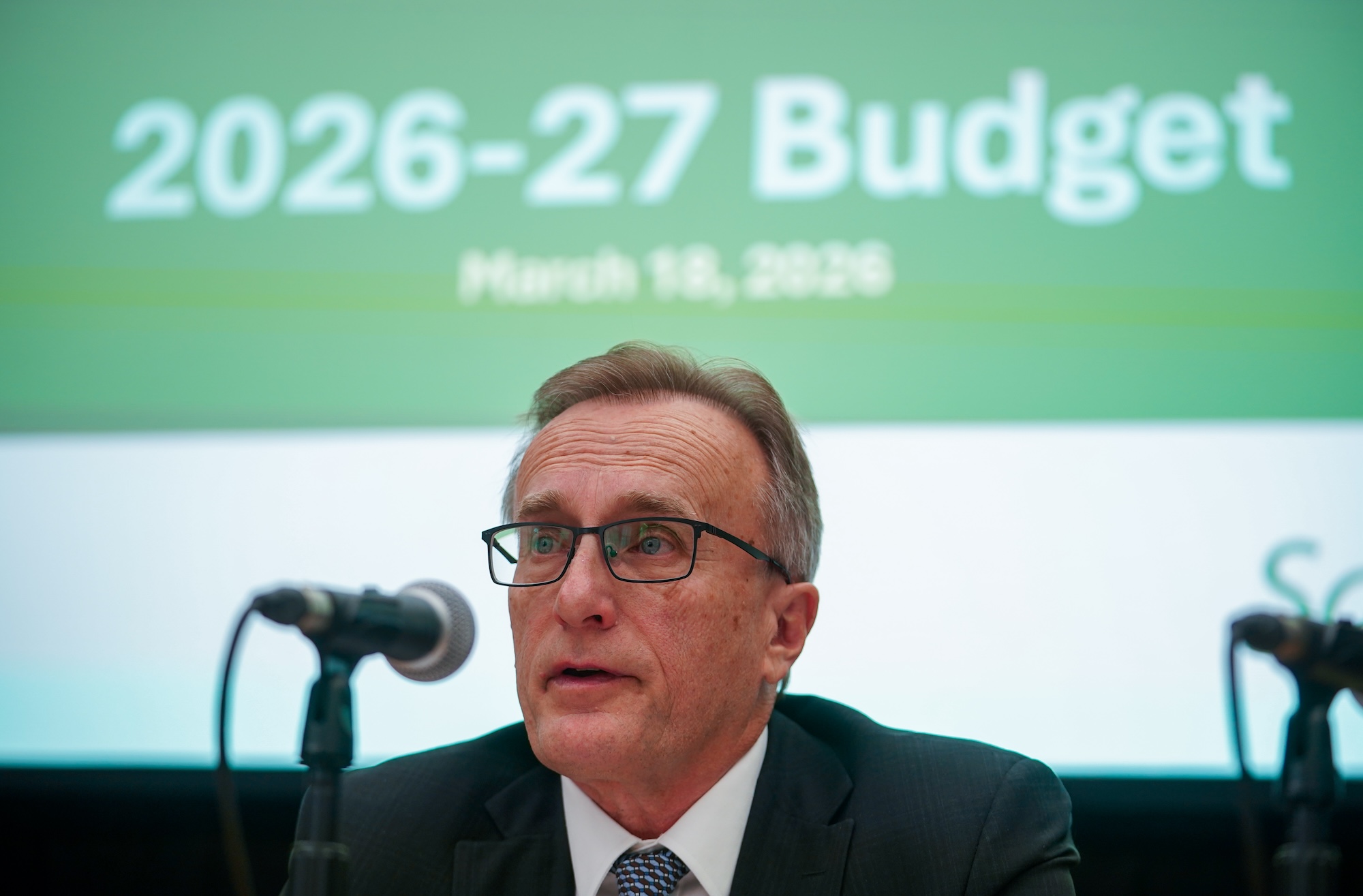
Finance Minister Jim Reiter presented the Saskatchewan Party’s 19th budget today, titled “Protecting Saskatchewan.” Budget 2026-27 is focused on protecting healthcare, education, and community services without raising taxes, amid projections of a revenue shortfall.
Signals about today’s budget were clearly articulated by Deputy Premier and Finance Minister Jim Reiter yesterday. Instead of the tradition of buying a new pair of shoes, this year he purchased protective treatment to take care of the shoes he already has. As Canada has seen record-breaking deficits across the country, this reflects a uniquely Saskatchewan perspective.
The optimism of a balanced budget last year—albeit narrowly—helped set the foundation for this year’s fiscal plan. The many global market uncertainties and geopolitical tensions during the last many months put a wrench in the projected balanced. The government was not able to make the 2025-26 budget balance a reality in the second half of the 2025-26 fiscal year, however it set the groundwork for this subsequent budget. Reiter commented early that during the budget process what kept him up at night was the level of volatility in the resource markets.
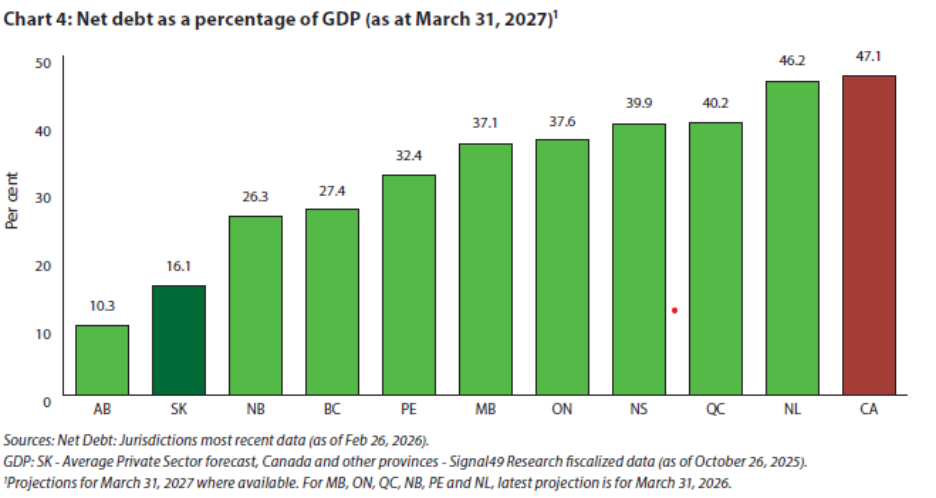
Nationally, Saskatchewan is still projected to have the second-lowest debt-to-GDP ratio in the country. This is also reflected in the province’s debt per capita, which stands at $641 per resident. By comparison, other western provinces that have recently tabled budgets with significant deficits report much higher figures: Alberta at $1,864 per capita and British Columbia at $2,340 per resident.
In this context, it’s a bold move to once again avoid raising taxes, pay-out the largest Municipal Revenue Sharing amount in the province’s history, and launch a new Patient First Health Care Plan, all within the same week. Instead, the government has accepted increased deficits and reduced fiscal capacity in the short-term to support economic stability and infrastructure development to ensure the preservation of the core services Saskatchewan needs.
“We could have increased some taxes. We could’ve not put as much funding into key areas like health care. We decided now is not the time to be doing that.”
– Jim Reiter, Saskatchewan Minister of Finance
Building upon the Health Human Resources Action Plan of last fiscal, the Patient First Health Care Plan is $8.5 billion dedicated to the ambitious plan of 90-day surgery timelines across many disciplines of health care. This is just one of the 50 new and ongoing improvements, upgrades and health programs.
As the Premier continues to emphasize, Saskatchewan is open for business. Small businesses, non-profit organizations, and corporations alike remain a central focus of the 2026–27 Budget.
The province is positioning itself to address economic uncertainty by fostering a competitive environment for small businesses while attracting large-scale investment. This includes recent announcements, alongside Bell, to build the largest AI data centre in Canada just outside Regina. Budget 2026–27 continues the government’s focus on reducing red tape and expanding international trade relationships through a growing network of trade offices.
With its 19th budget presented, the teenage years of the Saskatchewan Party have had its up’s and down’s. Throughout those years, a theme of fiscal restraint and an affinity for balanced budgets has guided the province to what may very well be the smallest deficit in the federation by years end. We may be able to attribute this to a uniquely Saskatchewan approach to handling the province’s financials, one rooted in pragmatism and fiscal discipline. Much like running a family farm, it reflects a mindset of working with available resources, adapting to changing conditions, and making the most of challenging circumstances.
For stakeholders looking to engage with Saskatchewan, understanding this underlying approach will be critical. Demonstrating alignment with these priorities, particularly around economic contribution, stability, and long-term value, will be key to meaningful engagement.
The headlines
Budget 2026-27 includes a projected $819.4-million deficit in the upcoming fiscal year and a newly forecasted $1.21-billion deficit for last year. The province plans to spend nearly an additional $1.2 billion this year, with most of the dollars going to health care, education, social services and policing.
Infrastructure investments and capital projects is a defining feature of the budget, remaining at record levels focused on health infrastructure, schools and post-secondary facilities, transport and roadways as well as crown corporation investments.
The government is increasing municipal funding through the municipal revenue sharing program, to its highest level in history. The provincial government says the program offers predictable, no-strings-attached funding based on three-quarters of one point of provincial sales tax revenue from two years prior.
Energy and resource volatility related to Canada-U.S. trade and geopolitical uncertainty continues to put pressure on the provinces fiscal planning.
Debt, deficit and revenue
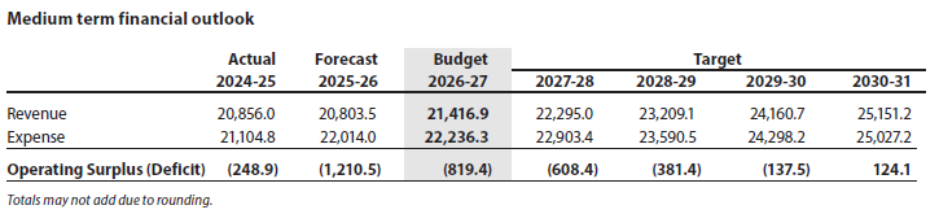
Total revenue is forecast to increase steadily over the medium term, rising from $21.4 billion in 2026, to $22.3 billion in 2027, and $23.2 billion in 2028. Over the same period, expenses are also expected to grow from $22.2 billion in 2026, to $22.9 billion in 2027, and $23.6 billion in 2028. The government has charted a difficult path back towards a balanced budget but does not reach one until 2030-31. For 2026‑27, the Budget projects a deficit of $819 million, narrowing to $608 million in 2027-28, and $381 million in 2028-29.
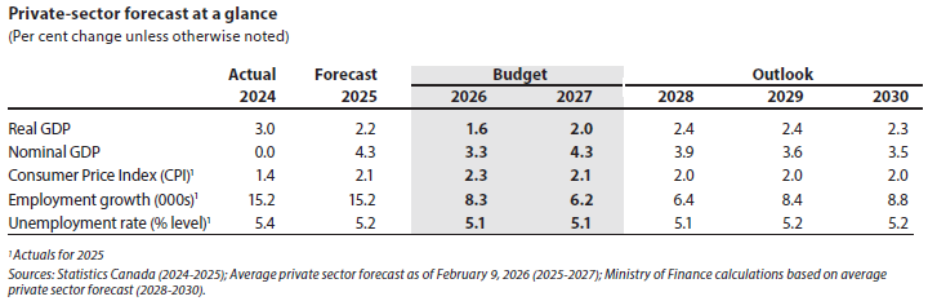
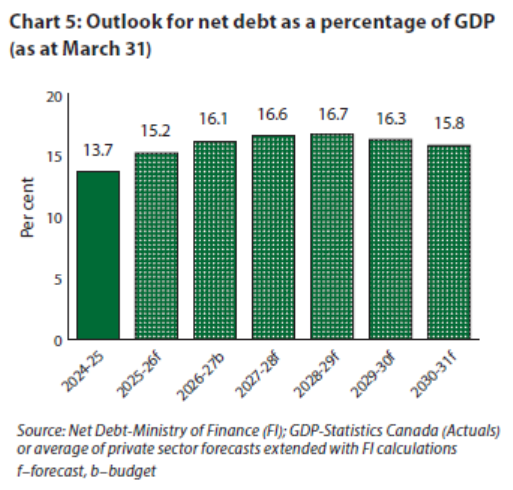
Real GDP is projected to rise over the projection period, increasing from 1.6 per cent in 2026 to 2.0 per cent in 2027, and 2.4 per cent in 2028. Despite the anticipated economic forecast, the net debt-to-GDP ratio is expected to rise over the projection period, increasing from 16.1 per cent in 2026-27, to 16.6 per cent in 2027-28, and 16.7 per cent in 2028-29.
Reducing costs
While austerity is often seen as a solution to reducing structural costs during difficult economic times, we have seen provinces throughout Canada resist this as a way to balance deficits. Saskatchewan is no exception to this. The government has highlighted they will aim to address rising costs through economic growth and capital spending.
One of the only significant cost-reduction measures included in the budget was the province’s vow to “operate within its means” in the form of managing the size of its workforce through attrition. Over the next two years, positions left vacant by retirements and voluntary departures will be reviewed. The process will allow the province to “right-size” its workforce by three per cent without eliminating filed positions or compromising front-line services.
Affordability measures
The 2026-27 budget continues to provide tax-related affordability measures that the Saskatchewan Party has promised or already implemented. It allocates approximately $2.5 billion annually across tax relief and targeted program spending. The 2024 Saskatchewan Affordability Act is the delivery vehicle of much of this approach with budget 2026-27 expanding tax credits for low-income households, caregivers, and families.
Housing measures emphasize both demand- and supply-side supports through tax credits, benefits, and construction incentives. Education-related tax measures aim to retain skilled labour. Additional cost relief is delivered through carbon tax savings and the continuation of a reduced small business tax rate, collectively signalling a broad-based strategy to mitigate cost-of-living pressures while maintaining core public services.
Investment in healthcare
The 2026–27 budget prioritizes healthcare system capacity and workforce stabilization, with total spending reaching $8.47 billion. Core funding to the Saskatchewan Health Authority underpins the frontline service delivery, while targeted investments focus on expanding primary care access, hospital capacity, and advancing the Health Human Resources Action Plan. Significant capital funding supports long-term infrastructure expansion.
Mental health and addictions remain a key policy priority, with increased funding directed toward treatment capacity, new facilities, and early-stage implementation of the Compassionate Intervention Act. Overall, the spending profile reflects a dual focus on acute service delivery as well as structural improvements to the system overall.
Agriculture
The 2026–27 budget reinforces agriculture as a core economic priority, with $662.7 million in total funding which is an increase of 6 per cent. The government’s investments emphasize sector resilience amid market and climate volatility, anchored by significant investments in business risk management programs such as crop insurance and income stabilization. Continued funding under the Sustainable Canadian Agricultural Partnership supports innovation, value-added production, and export competitiveness. Overall, the investments reflect the government’s two-pronged approach: stabilizing producer incomes in the short term while advancing long-term sector growth through technology adoption and market expansion.
Education & Advanced Education
The 2026–27 budget advances targeted investments in education and early learning, with total spending reaching $3.6 billion (+$100 million). Increased operating funding for school divisions supports classroom capacity enhancements, including specialized support classrooms and early literacy initiatives. Capital investments focus on new school construction and flexible infrastructure solutions to address enrolment pressures. Early learning and childcare funding also rises, with continued alignment under the renewed Canada-wide agreement to improve affordability and access. Overall, the spending reflects a balanced approach between system capacity expansion, targeted student supports, and long-term workforce and population growth needs.
Advanced education is positioned as both an affordability and workforce development lever in the budget, with total investments amounting to $847 million an increase of $59 million. a new multi-year funding agreement that will provide $250 million over four years. This agreement will provide post-secondary institutions with 3 per cent increase to operating funding each year. It also will limit annual tuition increases to a range of zero to three per cent. Of this funding, $119 million will support student affordability through a $68 million investment in the Graduate Retention Program and $9 million in the Saskatchewan Advantage Scholarship.
Targeted affordability measures, including graduate retention and scholarship programs, aim to reduce financial barriers and retain talent. Concurrently, expanded training capacity—particularly in healthcare fields—aligns post-secondary outputs with labour market needs. Overall, the framework integrates cost control with strategic skills development to support long-term economic growth.
Capital and infrastructure investments
The 2026 – 27 Budget includes a $4.3 billion capital plan, one of the largest in Saskatchewan’s history, with major investments in health, education, transportation, and government infrastructure. Health care receives the largest share, with $635.7 million earmarked for major projects such as the redevelopment of the Prince Albert Victoria Hospital, a new specialized long-term care facility in Regina, and additional urgent care centres, along with continued work on complex needs facilities and hospital expansions.
School infrastructure receives $123.8 million for new and ongoing capital projects across the province. The budget also provides $56.8 million for postsecondary infrastructure, including preventative maintenance and campus renewal planning. Transportation infrastructure sees $417.2 million to improve more than 850 kilometres of provincial highways, while $239 million is directed to municipalities for infrastructure projects. An additional $323.2 million will support government services infrastructure, including investments in IT, water systems, public safety equipment, and provincially owned housing.
Saskatchewan’s Crown corporations will invest a further $2.5 billion, led by $1.7 billion for SaskPower’s electricity system, to support economic growth and maintain essential utility infrastructure.
Immigration and career training
The 2026-27 Budget invests nearly $125 million in Immigration and Career Training to prepare Saskatchewan residents for the high-quality jobs emerging across the province’s economy. Major workforce development funding includes $21.8 million for adult essential skills training, $22.2 million for postsecondary training programs in in-demand sectors, $25.9 million for preemployment services, and $10.4 million to support persons with disabilities entering the workforce.
To support the Patients First Health Care Plan, $3.7 million will go toward training and settlement supports for critical health occupations, including funding for new training seats and credential recognition programs.
Opposition reaction
Saskatchewan NDP leader Carla Beck criticized the government’s tripling of the debt, inability to balance the budget, and failure to provide affordability relief. She said that her party would have prioritized affordability and offered measures of support, suggesting a temporary suspension of the gas tax. She pointed to increased power rates, hunting and fishing licences, and automobile insurance deductibles as signals that there is “nothing to offer a hint of hope or relief.”
There’s always going to be uncertainty, but what we’ve seen from this government is a lack of accountability. People in this province simply don’t have confidence in their numbers anymore and they can shrug off and try to shirk responsibility, but the fact is they’ve been in power 20 years now. If they were going to figure it out, I expect they would have done it by now. I don’t accept his excused.”
– Carla Beck, Leader of the Official Opposition
The opposition’s finance critic Trent Wotherspoon condemned the Party for the previous year’s incorrect forecast of a $12 million surplus, compared to the current deficit projection of $819 million, and pushing back the date to balance the budget from 2027 to 2031.