

On March 18th, 2026, Finance Minister Eric Girard tabled his eighth and final budget under the leadership of Premier Francois Legault as the Coalition Avenir Québec (CAQ) will announce a new leader in April, before heading to a provincial election by October 5th. The Minister described it as a measured budget, that comes at a difficult time both economically as well as internally with the looming leadership race. The lack of a solid political mandate applies a certain limit on the long-term applicability of any promises and ambitious fiscal plans. Current political polling also factors into how we should perceive this fiscal outlook, as any decisions included will be likely reviewed and revised by a new government with a fresh mandate following the October election.
The Minister foreshadowed the theme of today’s budget earlier in March, lowering people’s expectations of traditional pre-election budget full of enticing campaign like promises. Instead, Minister Girard described the upcoming fiscal plan as “sober and targeted” going as far to outright say there will be no campaign style investments and that areas such as education and healthcare will receive “adequate” funding.
All in all, there is little surprise within this budget. Budget 2026-27 meets the description of a technocratic exercise to some, while opposition highlights it falls short of delivering affordability solutions are central to Quebecers’ needs in an environment of trade tensions and global economic uncertainty.
Leadership races & polling
Despite the CAQ losing Quebecers’ confidence in recent years, the leadership race has attracted just over 5,500 new members, bringing the centre-right party’s total voting membership to 20,576, according to preliminary figures released by the CAQ. Recent polls show a lead for the former Minister of the Economy Christine Fréchette in the leadership race, after launching her candidacy in Trois-Rivières. The other leadership hopeful, former environment minister Bernard Drainville, launched his candidacy in the riding of Lévis, a week after Fréchette.
In a recent Pallas Poll, Fréchette holds a decisive advantage over Drainville for preferred premier, leading 47 per cent to 17 per cent. This preference is consistent across nearly all demographic groups and party affiliations. Crucially for the leadership race, a clear majority of CAQ supporters (57%) view Fréchette as the stronger potential premier, compared with 29 per cent for Drainville. The new leader of the party and next premier will be known on April 12th.
Charles Milliard, former CEO of the Fédération des chambres de commerce du Québec, became the new leader of the Quebec Liberal Party (PLQ) on February 13th, after no other candidates qualified for the race.
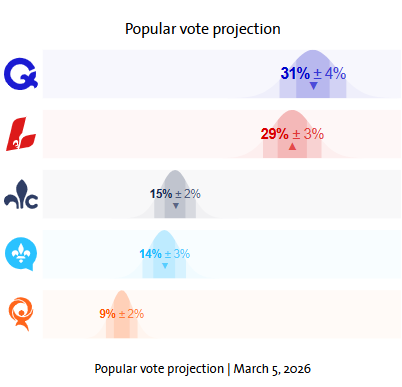
The Parti Québécois (PQ) appears to be experiencing a modest resurgence, emerging narrowly ahead of the PLQ in the latest polling on 338 Canada. With 31 per cent support, the PQ now leads in vote intention, positioning itself as a competitive alternative in Quebec’s evolving political landscape. However, this electoral momentum comes amid a broader shift in public attitudes: the same study shows support for Quebec sovereignty at just 29 per cent, its lowest level since the 1995 referendum. Behind the two front‑runners, the Conservative Party of Quebec sits in third place with 15 per cent support, followed by the CAQ at 13 per cent and Québec Solidaire at 9 per cent.
Key numbers
The $170.8-billion budget projects a deficit of $8.6-billion, which includes a $2-billion contingency reserve and a $2.3-billion legally required payment into a fund to repay the province’s debt.
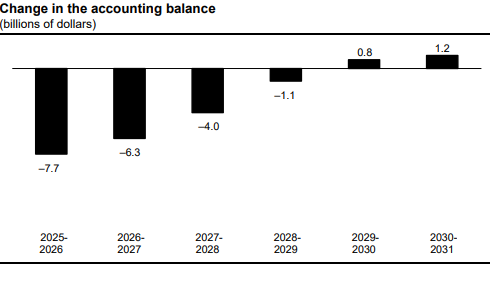
With the government’s sober spending, this year’s projected deficit is lower than expected, standing at $9.9 billion, which is down from an expected $12.4 billion projected late last year.The deficit is expected to gradually decline to $6.3 billion in 2026-27, $4 billion in 2027-28 and $1.1 billion in 2028-29 before balancing to a projected $800 million surplus in 2029-30.
As of March 31, 2026, Quebec’s deficit represents 1.2 per cent of GDP, which is below the Canadian average of 1.7 per cent.
Following growth of 0.8 per cent in 2025, real GDP is projected to increase by 1.1 per cent in 2026 and 1.4 per cent in 2027. These investments are expected to contribute an additional $630 million to Quebec’s GDP.
Net debt has declined by 4.1 per cent, from 42.9 per cent of GDP in March 2019 to 38.8 per cent in March 2026. The 2026–2027 deficit of $8.6 billion represents 1.3 per cent of GDP, down from 1.5 per cent in 2025–2026.
Overall, the 2026–2027 Quebec budget reflects moderate economic growth, targeted investments across key sectors, and a gradual path toward fiscal balance despite ongoing deficit and debt pressures. Minister Girard stated that the largest factor weighing on Quebec’s economic projections aside from global instability is the uncertainty looming over the renewal of the Canada-United States-Mexico Agreement.
Budget highlights
Over the next five years, the Quebec government will spend $9.6 billion to stimulate the economy, support businesses affected by expected continued tariffs, strengthen public services, protect purchasing power and support vulnerable populations.
Notably included in the budget is $250 million per year over the next five years which is set aside for the CAQ’s next leader to use for electoral promises.
The Government’s core missions
Budget 2026-27 will invest $4.3 billion to support the government’s self-declared core missions.
This includes $2.2 billion to improve access to health and social services, $639 million over five years to support educational success, and nearly $392 million to higher education, labour-market integration, and research. Public safety and legal services will be reinforced through nearly $1.1 billion over five years.
Accelerating economic transformation
In response to global trade uncertainty and rapid technological change, Quebec’s 2026-2027 budget commits more than $1.7 billion to accelerate economic transformation and support businesses, particularly small and medium-sized enterprises.
Measures include $693 million to help companies invest in future-oriented sectors, additional capitalization of up to $2 billion to support critical and strategic minerals, and a new $500 million loan-guarantee fund to enable Indigenous participation in economic projects.
The budget also streamlines approval processes for major projects, and allocates $283 million to strengthen innovation, research and advanced technologies including artificial intelligence (AI) and quantum.
Supporting Quebecers and communities with targeted action
The budget commits more than $3.6 billion over six years to address priority social issues, including the rising cost of living, access to housing, homelessness, mental health, domestic and sexual violence, and climate resilience.
Of this total, nearly $2.4 billion over five years supports families and vulnerable populations. An additional over $1 billion is dedicated to strengthening community resilience through investments in local and regional infrastructure, climate change adaptation initiatives such as Rénoclimat and LogisVert, environmental protection, and public services for Indigenous populations. Quebec culture and heritage are further supported with nearly $220 million in targeted funding.
Significant investments in public infrastructure to stimulate the economy
Public infrastructure and capital investment remains a cornerstone of the government’s strategy to stimulate the economy. The government will increase infrastructure spending by more than $5 billion over six years, bringing the Quebec Infrastructure plan (PQI) total to $167 billion.
Funding priorities include: health care, education, transportation, digital transformation, and regional infrastructure, with most investments dedicated to maintaining existing assets in good condition.
Opposition response
Opposition parties criticized the CAQ’s budget failures to address Quebecers’ core concerns, particularly the rising costs of housing, food, and transportation. The PQ noted that food and transit are among the areas most affected by inflation, yet said the government failed to offer any concrete relief.
Minister Girard is making a colossal sum available to Bernard Drainville and Christine Fréchette for their electoral platforms—money that wasn’t even clearly identified in the Québec government’s budget documents. It was the minister himself who announced it to the media. Worse still, he admitted that if that isn’t enough, he could dip into the contingency reserve. In reality, the CAQ has created an electoral war chest using public funds,”
– Pascal Paradis, Parti Québécois spokesperson.
The PLQ pointed to the $9.9 billion deficit reflecting years of mismanagement by the government. Opposition parties denounced the built-in budget flexibility amounting to $250 million annually over five years, or roughly $1.3 billion, calling it inappropriate at a time when Quebecers are facing affordability pressures. Liberal Leader Charles Milliard labelled the $8 billion contingency reserve over five years the “Fréchette-Drainville cushion”.
This is not the budget Quebecers deserve—it’s actually the opposite of what we need to generate wealth, which is what Québec needs most to be able to pay its bills.”
– Quebec Liberal Party
Opposition members acknowledged some targeted measures, such as additional funding for homelessness services, daycare subsidies, domestic-violence shelters, and automatic tax filing for low-income individuals. Nevertheless, they maintained these measures are insufficient to meaningfully ease economic strain. Critics across parties also said the plan to add only 1,000 affordable housing units over three years is far below what is needed to address the housing crisis. Québec solidaire also criticized the Québec Infrastructure Plan (PQI), particularly the continued delay of the Maisonneuve-Rosemont Hospital reconstruction, arguing it reflects the CAQ’s neglect of Montréal and major public projects despite repeated promises.
Minister Eric Girard will spend the summer with the next CAQ leader making it rain and handing out money that should have been used to help families who are barely getting by. Two hundred and fifty million dollars is a massive amount. The education system, the healthcare system, and families being crushed by their bills could have used that money immediately.”
– Ruba Ghazal, the Quebec solidaire spokesperson