

The Quebec National Assembly rose on December 12th following two weeks of intensive sittings, coinciding with a marked shift in political dynamics in the same period. The session wrapped up just over two weeks after the November economic update, where Premier Francois Legault released his renewed economic vision for the province, Quebec Power, and in this short time the entire political environment has changed dramatically.
Quebec Liberal Party (PLQ) in crisis
On December 18, 2025, Pablo Rodriguez announced his resignation as leader of the Quebec Liberal Pary (QLP), after months of internal party turmoil and allegations of vote-buying in his leadership election campaign last summer. Speaking at a news conference, Rodriguez said that he leaves the post with his “head held high,” adding that he has always conducted himself ethically and with integrity. He also acknowledged that the situation had become a distraction and that the focus should now be on the Quebec Liberal Party.
On assuming the leadership last June, Rodriguez did not have a seat in the National Assembly, so he asked Marwah Rizqy, a Liberal MNA to serve as Parliamentary Leader of the Party. She was dismissed by Rodriguez in November and suspended from the Liberal caucus, after she fired her Chief of Staff and close friend of Rodriguez’s, Geneviève Hinse.
Meanwhile, in November, the Journal de Montréal reported on alleged text messages suggesting that party members who supported Rodriguez during the election campaign had received cash rewards. Anti-corruption police in Quebec launched an investigation into allegations of the vote-for-cash scheme early December. Rodriguez then removed a second MNA from his caucus, Chomedey MNA Sona Lakhoyan Olivier for the duration of another investigation being led by the National Assembly’s ethics commissioner.
Rodriguez’s leadership over the past six months helped the Liberals secure second place in the polls as a legitimate potential alternative to the Parti Quebecois, which is currently enjoying a steady 16-point lead in the polls, at 38 per cent over the Liberals. While overall support for the Liberals has increased to 28 per cent most recently, the number of scandals over the fall quickly eroded any internal support he had built up within the party.
The wider political picture
The PQ’s steady lead also benefits greatly from another difficult legislative session for the Premier, with several contentious pieces of legislation and their repercussions dominating the news cycle and ultimately tarnishing the Premier’s personal popularity. Recent polling shows Mr. Legault has earned the title of least popular first minister in the country.
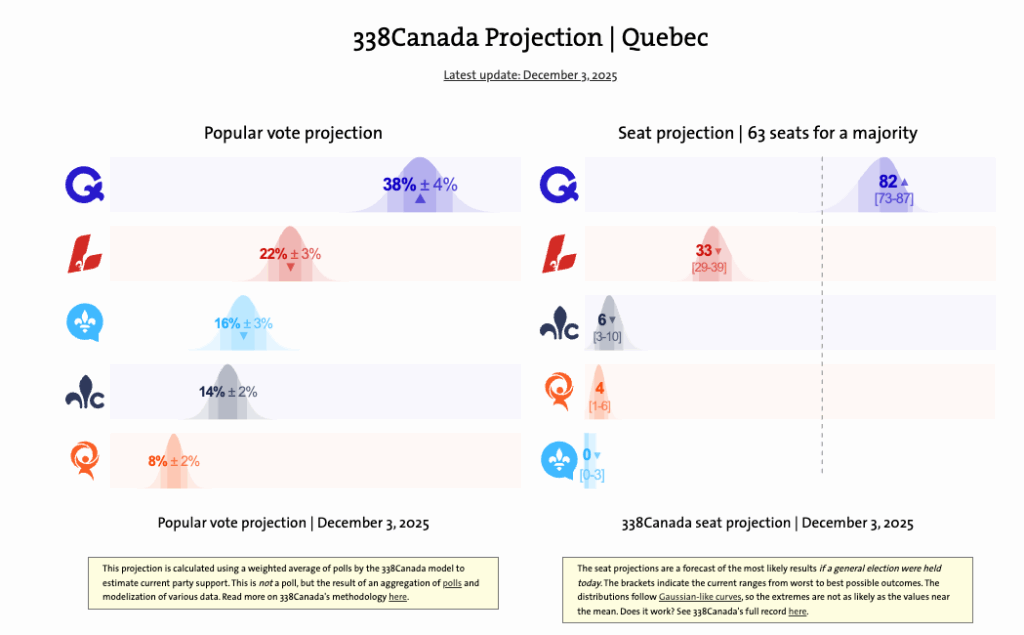
Despite his persisting decline in popularity, Premier Francois Legault recently took the proverbial walk in the sand—snow in this case—and came to the conclusion that he still sees a path forward for the CAQ in the next election and as he has said consistently, plans to to stay at the helm to see through the next election in October 2026.
On the legislative front, the CAQ was full steam ahead on its priorities using the intensive session to their advantage to pass and introduce a number of key bills. Much of their focus was on identity and language legislation, including Bill 1 the Constitution initiative and Bill 109 aimed at regulating content for content streamers in the province. The CAQ also put forward new legislation to reduce the regulatory burden and environmental processes that are considered to be limiting investment into key economic sectors of interest as designated by the province. This initiative focuses on renewable energy, efficiency in realizing strategic projects, interventionist investments, the Green Transition, data centres, security and defence, and critical and strategic minerals.
Here’s to the New Year
The Assembly is set to return on February 3rd, as the parties look to lock-in for the final stretch before the October election. Premier Legault will look to lean on the business credentials that originally helped him get elected and focus on improving the lives of Quebecers on a day-to-day basis. This could come in the form of implementing his new economic vision for the province, ensuring legislation related to streamlining approval processes for major projects is passed and ratifying its recent agreement with the Quebec Federation of General Practitioners. The PQ will hope to continue riding the wave of support, putting it well ahead of the rest in the polls, while the PLQ attempts to chip away at their lead. Recently, Pablo Rodriguez has spoken out against the PQ’s promised referendum if it wins the 2026 election. This opposition comes as a SOM poll published by La Presse indicated that 63 per cent of Quebecers do not want the third independence referendum. The PLQ hopes to capitalize on the notion that the PQ is a safe place to hold your vote if Quebecers are displeased with the CAQ, while it must also try to stem the bleeding from its continued internal crisis.
Key legislation
- Bill 1 – Quebec Constitution Act: Presentation stage.
- Bill 3 – An Act to improve the transparency, governance and democratic process of various associations in the workplace: Adopted in Principle
- Bill 5 – An Act to accelerate the granting of the authorizations required to carry out priority national-scale projects: Presentation stage.
- Bill 109 – Cultural Sovereignty of Québec: Assent granted December 12, 2025.
- Bill 7 – An Act to reduce bureaucracy, increase state efficiency and reinforce the accountability of senior public servants: Adopted in Principle
- Bill 9 – An Act respecting the reinforcement of laicity in Québec: Presentation stage.